PRINTED PAGE 1469NKJV · STUDY EDITION
Zechariah INTRODUCTION 1469
The ministries of Haggai and Zechariah did not cease when work began in earnest on the temple. The
prophets continued to encourage the people. Haggai’s messages were delivered in 520 b.c.; Zechariah’s last
dated prophecy was given in 518 b.c. (7:1). With the people committed to restoring the worship of the Lord
and the temple, God poured out His blessing on a repentant and spiritually revitalized people. The temple was
completed in 515 b.c. and rededicated with great rejoicing.
Purpose and Themes Zechariah’s prophecies had two purposes. First, they challenged the returning exiles
to turn to the Lord, to be cleansed from their sins and to experience again the Lord’s blessing (see 1:3). Second,
Zechariah’s words comforted and encouraged the people regarding the rebuilding of the temple and God’s
future work among His people (1:16, 17; 2:12; 3:2; 4:9; 6:14, 15).
In the first several chapters, Zechariah encourages the people by focusing on God’s choice of Jerusalem (1:17;
2:12; 3:2). The Lord had not set aside His ancient covenant people. Through Zechariah, God not only reaffirmed
Jerusalem’s divine election, but promised to come among His returning people and live in their midst (see 2:10,
11; 8:3, 23). It was through His personal presence among His people that God would accomplish a miraculous
work. In the second half of the book, Zechariah details God’s future dealings with His chosen people, revealing
the overthrow of Israel’s enemies, the future glories of Zion, and the universal reign of the Messiah. This is the
overarching theme of the book: The complete restoration of God’s people would occur in the redeeming and
delivering work of the coming Messiah.
Theology Zechariah teaches a great deal concerning the First and Second Comings of Jesus the Messiah. He
refers to the Messiah as the “BRANCH” (3:8), God’s “Servant” (3:8), and God’s “Shepherd” (13:7). There is also an
allusion to the Messiah’s ministry as a Priest-King in 6:13 (see Heb. 6:20—7:1). Furthermore, he prophesied the
Messiah’s entrance into Jerusalem on a colt (9:9; see Matt. 21:4, 5; John 12:14–16), His betrayal for 30 pieces of
silver (11:12, 13; see Matt. 27:9, 10), the piercing of His hands and feet (12:10; see John 19:37), and the cleansing
from sin provided by His death (13:1; see John 1:29; Titus 3:5). In fact, chapters 9–14 of Zechariah are the most
quoted section of the Prophets in the narratives of the Gospels.
Concerning the Messiah’s Second Coming, Zechariah prophesied such future events as the conversion of
Israel (12:10—13:1, 9; see Rom. 11:26), the destruction of Israel’s enemies (14:3, 12–15; see Rev. 19:11–16), and the
reign of Christ in a new Jerusalem (14:9, 16; see Rev. 20:4–6).
Along with his emphasis on the Messiah, Zechariah appropriately gives an important message about God’s
plan for salvation. The importance of repentance and returning to the Lord of Hosts is emphasized in the
introduction (1:3–6). And then in 3:1–5, Zechariah provides a striking illustration of the removal of sin and the
imputation of righteousness. The removal of the high priest’s filthy garments and the provision of clean festal
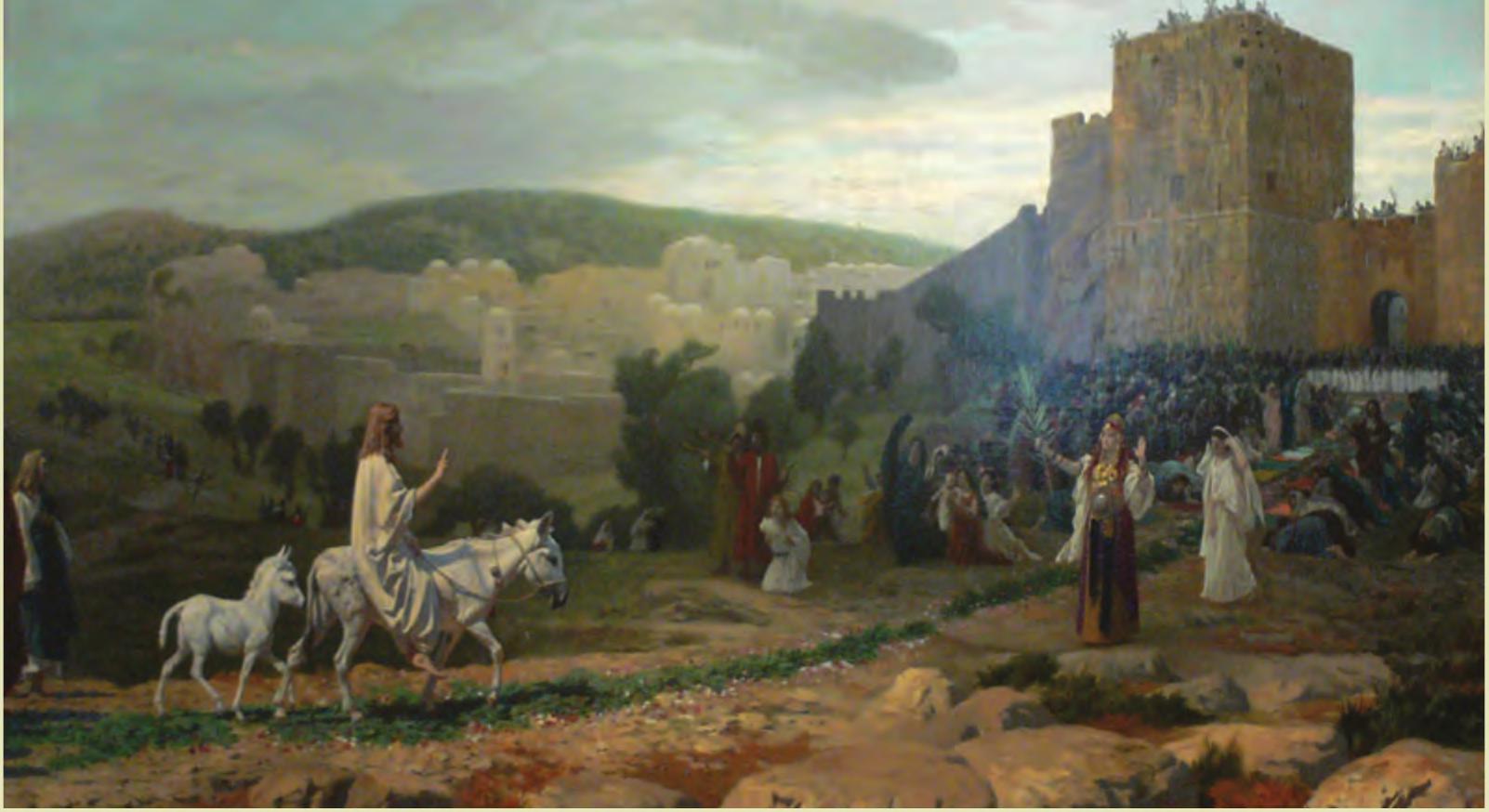
Christ’s entry into Jerusalem. Zechariah 9:9 prophesies that the messianic King would ride into Jerusalem on a
donkey (see Matt. 21:5; John 12:15).
WikiPaintings
Original illustrations
End of source page 1504