PRINTED PAGE 1457NKJV · STUDY EDITION
Zephaniah INTRODUCTION 1457
Themes Many books of proph-
ecy in the Bible speak of “the day
of the Lord” (especially the Book
of Joel). This day is a time of judg-
ment that includes both God’s
people (Israel and Judah) and the
surrounding nations. The prophet
Zephaniah scolded Judah’s leaders
for countless acts of wickedness
(3:1–7). His prophecies against the
nations included Philistia (2:4–7),
Moab and Ammon (2:8–11), Ethi-
opia (2:12), and Assyria (2:13–15).
These nations were judged
because of pride and arrogance
against God’s people and because
of their continuing idolatry.
But the last section of Zepha-
niah’s prophecy contains words of
hope (3:8–20): promises of protec-
tion for the remnant and promises
for the future of those who know
Him truly. In a future day, peoples of all nations will come to worship the Lord (2:11; 3:9). His own people will be
renewed in righteousness (3:11–13). And the King of kings Himself will rule in their midst (3:15; see Rev. 21:1–6).
That day of the Lord’s return will be a day of song and gladness. Even God will burst out in joyful singing (3:16,
17). The raging anger of the Lord (1:1, 2) will be replaced by His happy singing, for salvation will finally have
come to His people.
Christ in the Scriptures
Jesus seized on Zephaniah’s picture of the day of the Lord. On one occasion He
referred to Zephaniah 1:3, when He spoke of His second coming and gathering “out
of His kingdom all things that offend, and those who practice lawlessness” (Matt.
13:41). On another occasion, Jesus no doubt envisioned Zephaniah’s description of
“a day of wrath, a day of trouble and distress, a day of devastation and desolation,
a day of darkness and gloominess, a day of clouds and thick darkness, a day of
trumpet and alarm” (Zeph. 1:15, 16).
Although Zephaniah doesn’t specifically name the Messiah as the subject of
these scenarios, it is assumed. Who else could, as the prophet foretells, gather His
people and reign in victory?
Zephaniah Outline
I. A warning of impending judgment 1:1–18
A. The judgment announced 1:2–6
B. The judgment defined 1:7–13
C. The judgment described 1:14–18
II. A call to repentance 2:1—3:8
A. An invitation to repentance 2:1–3
B. A detailed warning of judgment 2:4—3:8
III. A promise of future blessing 3:9–20
A. The promise of conversion 3:9–13
B. The promise of restoration 3:14–20
640–609 b.c.
Josiah reigns in
Jerusalem
627 b.c.
Zephaniah’s
ministry begins
612 b.c.
Nineveh falls to
the Medes and
Babylonians
605 b.c.
Nebuchadnezzar’s
reign begins in
Babylon
586 b.c.
The Babylonians
destroy Jerusalem
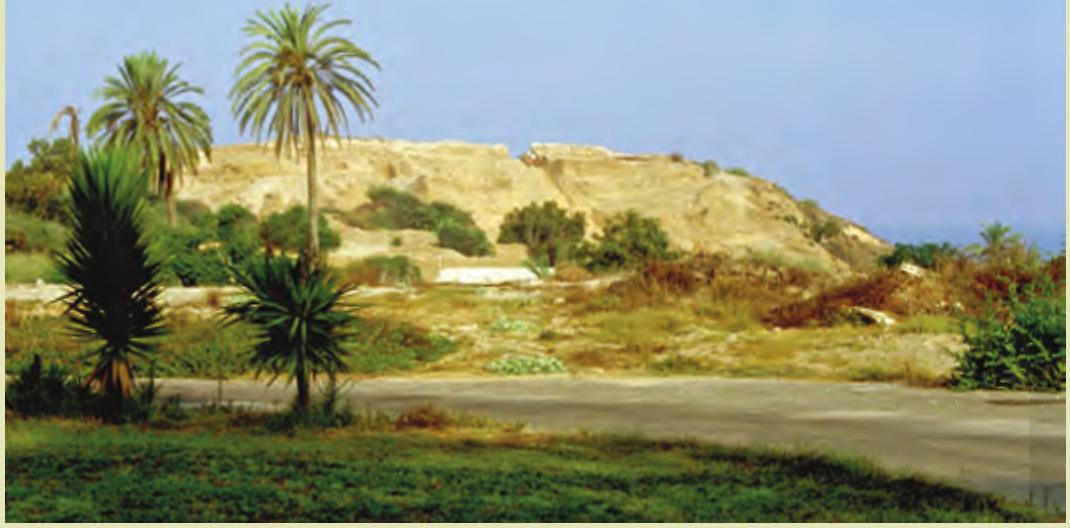
Ashkelon tell. A tell is a hill formed by the accumulated debris of many
ancient settlements one above the other. Ashkelon is one of the towns that
Zephaniah predicted would be destroyed (Zeph. 2:4).
© 1995 Phoenix Data Systems
Original illustrations
End of source page 1492