PRINTED PAGE 1432NKJV · STUDY EDITION
1432 Micah INTRODUCTION
to His mercy by the prophet Jonah (see Jon. 4:1–3). Second, although the judgment of Jerusalem was postponed,
it was finally realized in the destruction of the city by the Babylonians in 586 b.c.
Themes The interplay of texts of wrath and mercy in the Book of Micah mirrors the character of God, for
even in His wrath He remembers mercy. In the darkest days of impending judgment on the nations of Israel
and Judah, there was always the possibility of a remnant being spared. Although the Lord was determined to
maintain His holiness, He was equally intent on fulfilling His loving promises to Abraham (see Gen. 12; 15; 22).
The Lord would balance His judgment with mercy. Consequently Micah also balances his oracles of judgment
with oracles of promise.
In doing so, Micah points back to the covenant and also forward to the coming One. The book begins with
the language of a court. Micah calls the peoples of earth to come to hear the Lord’s case against Israel, for the
nation had broken the covenant (3:1; 6:1–3). The language recalls the language of the covenant or contract the
Lord established with His people. The Lord was judging His people according to the terms of the covenant. But
in the middle of the oracles of judgment, Micah reveals the Lord’s wonderful promises of a glorious future. There
would be a time when the coming King would gather His people together (2:12, 13), when He would establish
peace (4:3), and when He would bring justice to the earth (4:2, 3). Remarkably, Micah prophesies that this coming
Messiah would be born in Bethlehem (5:2). The fulfillment of this prophecy in Jesus’ birth in Bethlehem gives
us confidence that the prophecies of Jesus’ glorious future will also be fulfilled (see Matt. 2:1).
Christ in the Scriptures
Unlike the Book of Jonah, which took the burial and resurrection of Jesus for Israel to make sense out of what
had occurred, Micah’s reference to the Messiah was quite explicit. From the time he verbalized God’s rebuke at
the way the Jews were treating the poor until the time a poor carpenter and his fiancée arrived in Bethlehem,
devout Jews knew that King David’s birthplace was where the Messiah would also be born.
Micah wrote the following about the town of Bethlehem seven hundred years before Jesus was born:
“Though you are little among the thousands of Judah, yet out of you shall come forth to Me the One to be
Ruler in Israel, whose goings forth are from of old, from everlasting” (5:2). And of that Ruler, he prophesied, “He
will teach us His ways, and we shall walk in His paths. . . . Nation shall not lift up sword against nation, neither
shall they learn war anymore” (4:2, 3).
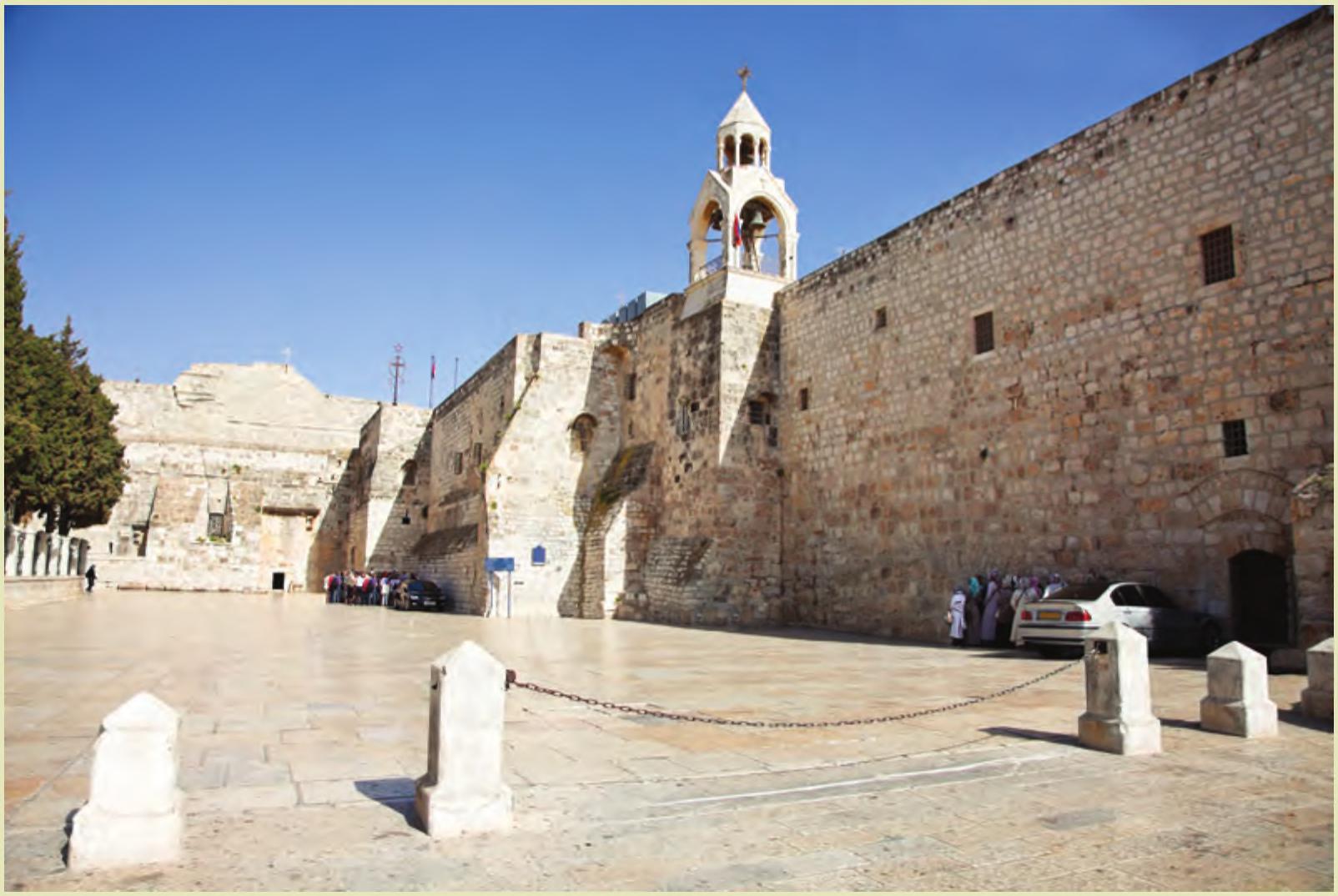
The Church of the Nativity, built on the traditional location of the birth of Christ. Micah prophesied that the Messiah
would come from Bethlehem (Mic. 5:2).
© Aleksandar Todorovic/Shutterstock
Original illustrations
End of source page 1467