PRINTED PAGE 1429NKJV · STUDY EDITION
Jonah 4:2 | 1429
CHAPTER 3
3 1 Exact meaning
unknown
4 a [Deut. 18:22]
5 b [Matt. 12:41;
Luke 11:32]
6 c Job 2:8
7 d 2 Chr. 20:3; Dan.
3:29; Joel 2:15 2 Lit.
great ones
8 e Is. 58:6 f Is. 59:6
9 g 2 Sam. 12:22;
Joel 2:14; Amos 5:15
10 h Ex. 32:14; Jer.
18:8; Amos 7:3, 6
eat, or drink water. 8 But let man and
beast be covered with sackcloth, and
cry mightily to God; yes, e let every
one turn from his evil way and from
f the violence that is in his hands.
9 g Who can tell if God will turn and
relent, and turn away from His fierce
anger, so that we may not perish?
10 h Then God saw their works, that
they turned from their evil way; and God
relented from the disaster that He had
said He would bring upon them, and He
did not do it.
Jonah’s Anger and God’s Kindness
4
But it displeased Jonah exceedingly,
and he became angry. 2 So he prayed
to the LORD, and said, “Ah, LORD, was not
this what I said when I was still in my
city, 1 a three-day journey in extent. 4 And
Jonah began to enter the city on the first
day’s walk. Then a he cried out and said,
“Yet forty days, and Nineveh shall be
overthrown!”
The People of Nineveh Believe
5 So the b people of Nineveh believed
God, proclaimed a fast, and put on sack-
cloth, from the greatest to the least of
them. 6 Then word came to the king of
Nineveh; and he arose from his throne
and laid aside his robe, covered himself
with sackcloth c and sat in ashes. 7 d And
he caused it to be proclaimed and pub-
lished throughout Nineveh by the decree
of the king and his 2 nobles, saying,
Let neither man nor beast, herd nor
flock, taste anything; do not let them
3:4 Jonah proclaimed that there were only forty days before the
destruction of Nineveh. Both the announcement and the specified
delay show God’s mercy. It was this mercy that bothered Jonah
(4:1–3).
3:5 believed God: The term used for God here is the general term
for deity. In contrast, the sailors in ch. 1 proclaimed faith in the Lord,
using the personal, covenant name for God (1:16). The fact that the
writer does not use the personal name for God here may suggest
that the Ninevites had a short-lived or imperfect understanding of
God’s message. History bears this out: We have no historical record
of a lasting period of belief in Nineveh. Eventually the city was de-
stroyed, in 612 b.c.
3:5, 6 fast . . . sackcloth . . . ashes: These are expressions of mourn-
ing and lamentation (see 2 Kin. 19:1; 2 Chr. 20:3; Is. 58:5–9; Jer. 36:6–9;
Joel 1:13, 14; 2:12–18).
3:7 proclaimed and published: The king’s edict reached all of
Nineveh.
3:9 God will turn and relent: The reversal of the threat to destroy
Nineveh depended solely on the grace and mercy of the Lord. At
times, the announced judgment of God is not His real intent (see 4:2;
Jer. 18:7, 8; Amos 7:3). Such announcements usually include offers
of mercy and forgiveness (see Zeph. 2:1–3).
3:10 God relented: The Ninevites’ repentance moved the Lord to
extend grace and mercy to them.
4:1 Jonah . . . became angry: In contrast to God, Jonah had no
compassion on the people of Nineveh. displeased: Jonah’s irri-
tation belied the good news that the city would be spared. Jonah
himself had just been spared God’s fair judgment, but he was unable
to appreciate the parallel.
4:2 I know: Jonah himself had experienced the excellencies of
0
300 miles
0
300 km.
Tyre
Arvad
Byblos
Joppa
Gath Hepher
Nineveh
Mari
Asshur
Tadmor
Carchemish
E
G
Y
P
T
A
S
S
Y
R
I A
T
A
R
S
H
I
S
H
?
B
l
a
c
k
S
e
a
Red
Se
a
C
Eu
ph
ra
te
s
R
.
Tig
r
i
s
R
.
G
r
e
a
t
S
e a
Intended journey
Actual journey
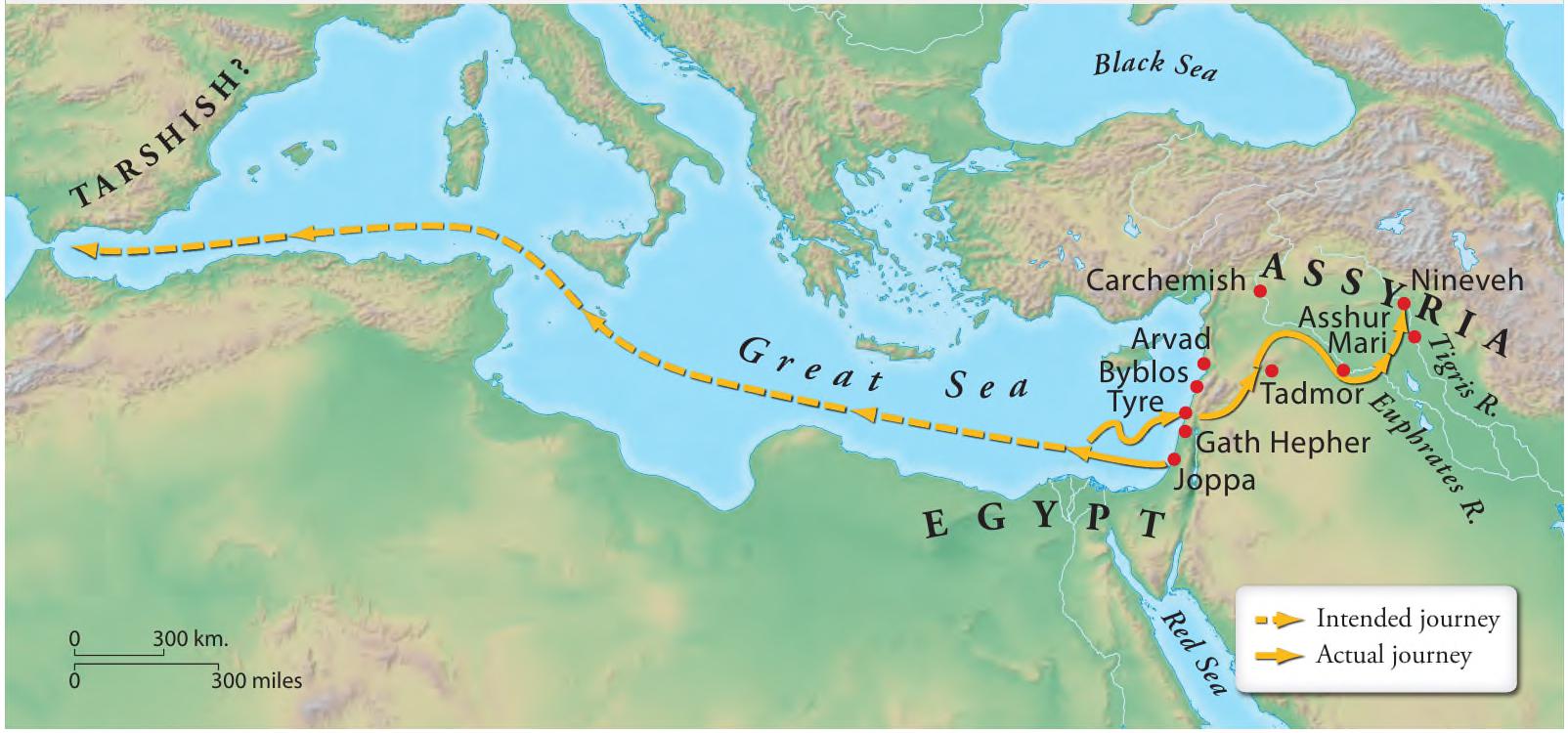
Nineveh and Tarshish represented opposite ends of the Mediterranean commercial sphere in ancient times. The
story of Jonah extends to the boundaries of OT geographic knowledge and provides a rare glimpse of seafaring
life in the Iron Age. Inscriptions and pottery from Spain demonstrate that Phoenician trade linked the far distant
ends of the Mediterranean, perhaps as early as the twelfth century b.c.
The Book of Jonah
Original illustrations
End of source page 1464