PRINTED PAGE 1424NKJV · STUDY EDITION
1424 Jonah INTRODUCTION
association. A “dove” could also be a symbol of silliness (see Hos. 7:11), a description that sadly applies to this
tragicomical prophet.
Historical Setting By the time of the ministry of Jonah, Assyria was preoccupied with the mountain tribes
of Urartu, and did not continue its westward campaigns until Tiglath-Pileser III came to power in 745 b.c. Israel
rejoiced at this preoccupation of Assyria, and they aggressively pursued a policy of defense by strengthening
their fortified cities, building up the army, and developing international relations.
Principal Message The Book of Jonah challenges God’s people not to exalt themselves over others. The
Lord, the great King, is free to bless, to be gracious, and to be patient with all the nations of the earth. More
than that, He may show compassion even on the wicked. Indeed, His mercy extends even to animals (4:11).
Jonah’s view of God was too restrictive. He believed that God was the Creator of everything, but that He was
compassionate only toward the elect of Israel. Jonah believed that since God had chosen Israel from among
the wicked nations, He had to show mercy to Israel, even if the people were rebellious. Jonah had failed to
appreciate that the Lord may be equally forbearing with other nations as He was with Israel.
The Book of Jonah affirms God’s freedom, sovereignty, and power. God is sovereign because He is the Creator
of everything (1:9). His power extends over all creation (the storm, the fish, the vine, the worm). God is free and
He can never be bound by human misconceptions.
The self-righteous make the grave mistake of rejoicing only in their own deliverance (2:9) and in God’s answers
to prayer (4:6). They miss out by narrowing God’s grace and mercy to themselves. Like Jonah, they cannot share
in God’s delight in saving the sailors and the city of Nineveh, including infants and even animals (4:11). They
confess that God is Creator and King of the whole cosmos, but restrict His involvement to judgment, justice,
and retribution. In this manner they do not see His acts of compassion, righteousness, and forbearance. The
Lord’s final proclamation to Jonah (4:10, 11) sums up the prophetic message of the book: God is free to bestow
His mercy on anyone and anywhere He wills. His concern and mercy extend to all creation.
Jonah’s story contains a strong warning to all godly people. The elect may miss the blessing of seeing God’s
grace extended outside their own sphere because of their imposition of limits on God. While Jonah was praying
anxiously for his personal deliverance, the sailors had already been experiencing the love of God for three days.
Likewise, the people of Nineveh who repented of their sin rejoiced that the impending judgment had not come.
Jonah, however, was miserable. As we laugh at him, we may need to wince at ourselves. Jonah’s silly sin is finally
no laughing matter. We are condemned along with him if we share in his provincial folly.
Literary Form As already noted, the literary form of the Book of Jonah differs from that of other prophetic
books. It has no prophecies. Instead, the book is largely narrative. Chapter 2 is a song of deliverance, a lovely,
vibrant lyric prayer like many in the Book of Psalms.
It is best to understand the book as a prophetic parable. The events in the book are historical, but its place
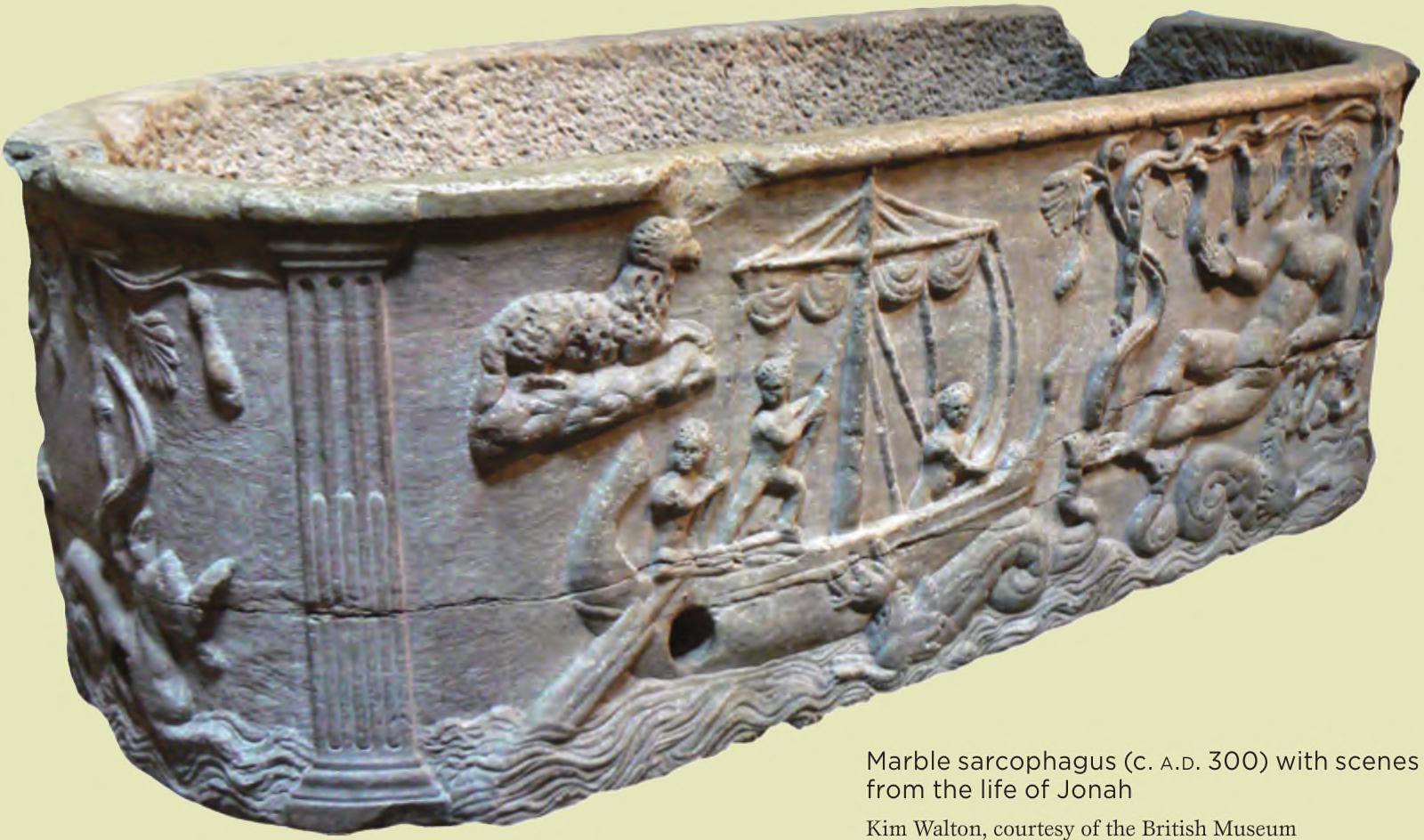
Marble sarcophagus (c. a.d. 300) with scenes
from the life of Jonah
Kim Walton, courtesy of the British Museum
Original illustrations
End of source page 1459