PRINTED PAGE 1405NKJV · STUDY EDITION
Amos 1:5 | 1405
1:1—2:16 The Lord sent Amos, a Judean, to Bethel to prophesy of
coming judgment on Israel. But in Bethel, Amos faced a hostile au-
dience. Israel’s first king, Jeroboam I, had made the town a center of
pagan worship. Because the temple in Jerusalem was in Judah and
not in the nation of Israel, Jeroboam had encouraged the Israelites
to worship at Bethel instead of Jerusalem. Thus the Israelites who
gathered at Bethel would regard Amos, a Judean, with suspicion. Yet
Amos bravely condemned the sins of Israel’s neighbors—the Syri-
ans, Philistines, Phoenicians, Edomites, Ammonites, and Moabites.
Then he went on to point out the iniquity of Judah and Israel: They
had rejected the God who had covenanted with them. They too
stood before God condemned by their own evil ways.
1:1 Tekoa was about ten miles south of Jerusalem, in a region
well-suited for raising sheep and goats. The earthquake, men-
tioned again in Zech. 14:5, cannot be dated precisely.
1:2 The temple was on Mt. Zion, the oldest part of Jerusalem.
When the Lord roared from there, the nation dried up at the heat of
the fiery blast. The fact that the top of Carmel, a mountain on the
coast of Israel in the north, withers indicates a great disaster. Mount
Carmel was a garden spot, normally lush and flourishing year-round.
1:3 Thus says the Lord: There was no mistaking by whose author-
ity these messages were spoken: this was the word of God Himself.
For three . . . and for four: This stylistic device indicated the ex-
haustion of God’s patience—the Syrians had continued to sin. This
device is repeated as Amos speaks God’s words against nation after
sinful nation. The transgressions of the neighbors of Israel and
Judah were against the general revelation, or “law of nature,” that all
people recognize and acknowledge. Since the neighboring nations
had not received God’s special revelation, as Israel had at Mt. Sinai,
Amos’s oracles did not call them to account by that standard, but by
the standard they had received. Damascus was the capital of Syria
(also called Aram), a powerful kingdom that had been a frequent
adversary of Israel throughout its history. Israelites listening to Amos
would have been glad to hear of God’s punishment of Damascus.
Gilead was the region on the east side of the Jordan from the Yar-
muk River to the Dead Sea. It had belonged to Israel since they had
taken over the land, but Aram often had fought Israel for possession
of northern Gilead, gaining control there in Israel’s times of military
weakness. Threshed . . . with implements of iron indicates ex-
treme cruelty and inhumanity in warfare.
1:4 I will send a fire . . . Which shall devour the palaces: Fire in
an ancient city was a real threat. Cities were crowded with houses
close together on very narrow streets; there was too little water to
effectively fight raging fires. Hazael and Ben-Hadad were kings
of Syria who had been particularly harsh in their treatment of Israel.
1:5 The gate bar was the large timber that barred the city gate from
the inside. If it was broken, the city would lose its security and could
be captured easily. Aven . . . Beth Eden: Amos may have intended
a play on words here. Aven means “Sin” in Hebrew; Damascus was a
verdant oasis city on the edge of the desert that could be compared
to Eden. However, Amos may also have been referring to the Beth
Eden region on the north bank of the Euphrates River. Kir is where
the Assyrian king Tiglath-Pileser III exiled the Syrians of Damascus in
732 b.c. Amos later referred to Kir as the place from which the Syrians
had originally come (9:7).
CHAPTER 1 1 a 2 Kin. 3:4; Amos 7:14 b 2 Sam. 14:2; Jer. 6:1 c 2 Kin. 15:1-7; 2 Chr. 26:1-
23; Is. 1:1; Hos. 1:1 d 2 Kin. 14:23-29; Amos 7:10 e Zech. 14:5 2 f Is. 42:13; Jer. 25:30;
Joel 3:16 g 1 Sam. 25:2; Is. 33:9 3 h Is. 8:4; 17:1-3; Jer. 49:23-27; Zech. 9:1 i 2 Kin. 10:32,
33 4 j Jer. 49:27; 51:30 k 1 Kin. 20:1; 2 Kin. 6:24 5 l 2 Kin. 14:28; Is. 8:4; Jer. 51:30; Lam.
2:9 1 Rules 2 Lit. House of Eden
T
he words of Amos, who was
among the a sheepbreeders of
b Tekoa, which he saw concern-
ing Israel in the days of c Uzziah
king of Judah, and in the days of d Jero
boam the son of Joash, king of Israel, two
years before the e earthquake.
2 And he said:
“ The LORD f roars from Zion,
And utters His voice from
Jerusalem;
The pastures of the shepherds
mourn,
And the top of g Carmel withers.”
Judgment on the Nations
3 Thus says the LORD:
“ For three transgressions of
h Damascus, and for four,
I will not turn away its punishment,
Because they have i threshed Gilead
with implements of iron.
4 j But I will send a fire into the house
of Hazael,
Which shall devour the palaces of
k Ben-Hadad.
5 I will also break the gate l bar of
Damascus,
And cut off the inhabitant from the
Valley of Aven,
And the one who 1 holds the scepter
from 2 Beth Eden.
The people of Syria shall go captive
to Kir,”
Says the LORD.
0
10 miles
0
10 km.
Dan
Samaria
Jerusalem
Tekoa
Bethel
Damascus
Ashdod
Ashkelon
Gaza
Tyre
Ekron
Beersheba
Rabbah
Sea of
Galilee
Dead
Sea
Jo
r
d
an
R.
I
S
R
A
E
L
J
U
D
A
H
P H
I L
I S
T
I A
M
O
A
B
A
M
M
O
N
S
Y
R
I
A
P H
O E
N I
C I
A
G
I
L
E
A
D
M e
d i
t e
r r
a n
e a
n
S e
a
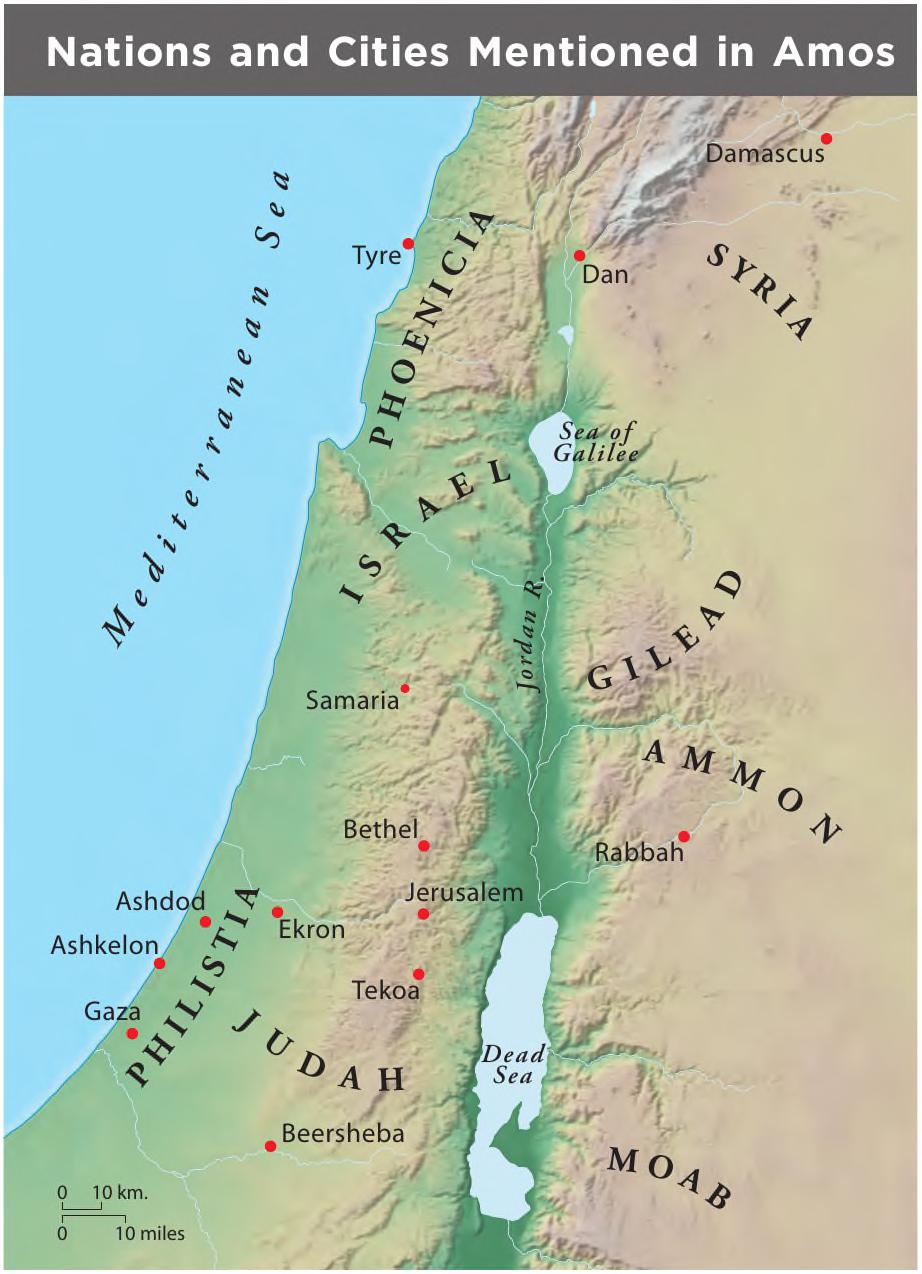
Nations and Cities Mentioned in Amos
Original illustrations
End of source page 1440