PRINTED PAGE 1384NKJV · STUDY EDITION
1384 | Hosea 5:11
The Law warned that altering a boundary in this way would bring
a special judgment from God (see Deut. 19:14; 27:17; Prov. 22:28).
5:12 As a moth slowly destroys clothing, so the Lord would destroy
Israel (see Job 13:28; Is. 50:9; 51:8). Rottenness elsewhere refers to
bone or tooth decay (see Prov. 12:4; 14:30; Hab. 3:16).
5:13 Both Israel and Judah sought protection through alliances
with Assyria, but the cruel Assyrians were more interested in ex-
ploiting God’s people politically and economically. King Jareb
probably refers to Tiglath-Pileser III, with whom both Israel and
Judah formed alliances (see 2 Kin. 15:19, 20; 16:7–9).
5:14, 15 Attacking like a ferocious, invincible lion, God would scat-
ter His people as judgment for their treachery. But the purpose of
the Lord’s discipline was to drive the people to earnestly seek
Him. The Hebrew verb for earnestly seek suggests eager longing
and desire (see Job 24:5; Ps. 63:1).
6:1 After being torn by the divine lion (5:14), the people would come
to their senses and seek to renew their allegiance to the Lord.
6:2 two days . . . the third day: The reference here is to a short
time period. When God’s people truly repent, God is eager to restore
His relationship with them. The people’s hope for revival was consis-
tent with God’s ancient promises through Moses (see Deut. 30:1–3).
6:3 God’s restored presence and blessings would be like the rain
that waters and renews the earth. latter and former rain: The
latter rains of Israel came in the spring and caused the plants to
grow. The former rains came in the autumn and softened the ground
for plowing and sowing.
6:4 Any apparent faithfulness that Hosea’s generation displayed
was short-lived and disappeared as quickly as fog or dew before
sunlight.
6:5 words of My mouth: The prophets announced God’s destruc-
tive judgments, which then fell on His unrepentant people. your
judgments are like light that goes forth: This comparison sug-
gests that God’s judgment, like bright sunlight, was obvious to all; or
that like a bolt of lightning or a blinding flash of light, it came swiftly.
3 e Is. 54:13 f 2 Sam. 23:4 g Ps. 72:6; Joel 2:23 h Job 29:23
5 i [Jer. 23:29] 2 Or the judgments on you
11 m Deut. 28:33
n Mic. 6:16
12 o Prov. 12:4
13 p Jer. 30:12-15
q 2 Kin. 15:19; Hos.
7:11; 10:6
14 r Ps. 7:2; Lam.
3:10; Hos. 13:7, 8
s Ps. 50:22
15 4 Lit. become
guilty or bear
punishment
CHAPTER 6
1 a Is. 1:18; Acts
10:43 b Deut. 32:39;
Hos. 5:14 c Jer.
30:17; Hos. 14:4
1 Bandage
2 d Luke 24:46;
Acts 10:40; [1 Cor.
15:4]
14 For r I will be like a lion to Ephraim,
And like a young lion to the house
of Judah.
s I, even I, will tear them and go away;
I will take them away, and no one
shall rescue.
15 I will return again to My place
Till they 4 acknowledge their offense.
Then they will seek My face;
In their affliction they will earnestly
seek Me.”
A Call to Repentance
6
Come, a and let us return to the
LORD;
For b He has torn, but c He will
heal us;
He has stricken, but He will 1 bind
us up.
2 d After two days He will revive us;
On the third day He will raise us up,
That we may live in His sight.
3 e Let us know,
Let us pursue the knowledge of the
LORD.
His going forth is established f as the
morning;
g He will come to us h like the rain,
Like the latter and former rain to the
earth.
Impenitence of Israel and Judah
4 “ O Ephraim, what shall I do to you?
O Judah, what shall I do to you?
For your faithfulness is like a
morning cloud,
And like the early dew it goes away.
5 Therefore I have hewn them by the
prophets,
I have slain them by i the words of
My mouth;
And 2 your judgments are like light
that goes forth.
I will pour out My wrath on them
like water.
11 Ephraim is m oppressed and broken
in judgment,
Because he willingly walked by
n human precept.
12 Therefore I will be to Ephraim like a
moth,
And to the house of Judah o like
rottenness.
13 “ When Ephraim saw his sickness,
And Judah saw his p wound,
Then Ephraim went q to Assyria
And sent to King Jareb;
Yet he cannot cure you,
Nor heal you of your wound.
Bible Times & Culture Notes
The Morning Dew
Palestine’s rainfall is directly related to the latitude and elevation
of the land. The mountainous regions in northern Galilee receive
the most rain (24 to 36 inches),
while the southern plains get
very little (4 to 8 inches). An
estimated 60 to 70 percent
of the precipitation is lost
through evaporation because
of the land’s high temperatures
and low humidity. Only 10 to 25
percent is absorbed for agricul-
tural purposes. So the dew that
falls approximately 250 nights
of the year is very essential.
Some
vegetation
depends
entirely on the dew’s moisture.
It is an exhilarating experience
to wake up in the Negev desert
on a summer morning and see
a thick fog! Yet the dew evap-
orates quickly, and it became
proverbial to compare Israel’s
faithlessness to “a morning
cloud . . . the early dew [that]
goes away” (6:4).
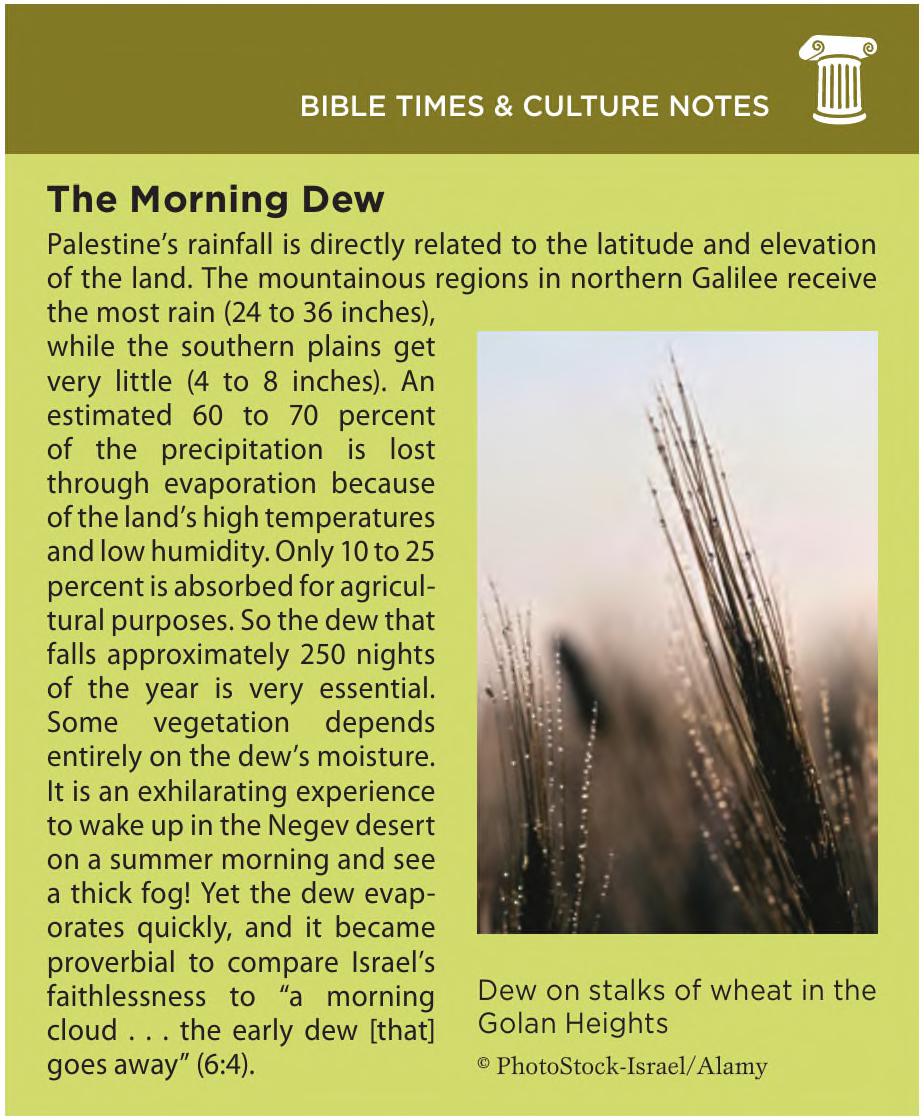
Dew on stalks of wheat in the
Golan Heights
© PhotoStock-Israel/Alamy
Original illustrations
End of source page 1419