PRINTED PAGE 1382NKJV · STUDY EDITION
1382 | Hosea 4:6
6 g Is. 5:13 h Ezek.
22:26
7 i 1 Sam. 2:30; Mal.
2:9 3 So with MT,
LXX, Vg.; scribal
tradition, Syr., Tg.
They will change
4 So with MT, LXX,
Syr., Tg., Vg.; scribal
tradition My glory
8 5 Desires
9 j Is. 24:2; Jer. 5:30,
31; 2 Tim. 4:3, 4
6 repay
10 k Lev. 26:26; Is.
65:13; Mic. 6:14;
Hag. 1:6
11 l Prov. 20:1; Is.
5:12; 28:7
12 m Jer. 2:27 n Is.
44:19, 20 7 Diviner’s
rod
13 o Is. 1:29; 57:5, 7;
Jer. 2:20; Ezek. 6:13;
20:28 p Amos 7:17;
[Rom. 1:28-32]
14 q Deut. 23:18
15 r Hos. 9:15; 12:11
s 1 Kin. 12:29; Josh. 7:2; Hos. 10:8 t Jer. 5:2; 44:26; Amos 8:14
8 Lit. House of Idolatry or Wickedness
10 For k they shall eat, but not have
enough;
They shall commit harlotry, but not
increase;
Because they have ceased obeying the
LORD.
The Idolatry of Israel
11 “ Harlotry, wine, and new wine
l enslave the heart.
12 My people ask counsel from their
m wooden idols,
And their 7 staff informs them.
For n the spirit of harlotry has caused
them to stray,
And they have played the harlot
against their God.
13 o They offer sacrifices on the
mountaintops,
And burn incense on the hills,
Under oaks, poplars, and terebinths,
Because their shade is good.
p Therefore your daughters commit
harlotry,
And your brides commit adultery.
14 “ I will not punish your daughters
when they commit harlotry,
Nor your brides when they commit
adultery;
For the men themselves go apart with
harlots,
And offer sacrifices with a q ritual
harlot.
Therefore people who do not
understand will be trampled.
15 “ Though you, Israel, play the harlot,
Let not Judah offend.
r Do not come up to Gilgal,
Nor go up to s Beth 8 Aven,
t Nor swear an oath, saying, ‘As the
LORD lives’—
The prophet also shall stumble with
you in the night;
And I will destroy your mother.
6 g My people are destroyed for lack of
knowledge.
Because you have rejected knowledge,
I also will reject you from being
priest for Me;
h Because you have forgotten the law
of your God,
I also will forget your children.
7 “ The more they increased,
The more they sinned against Me;
i I 3 will change 4 their glory into
shame.
8 They eat up the sin of My people;
They set their 5 heart on their
iniquity.
9 And it shall be: j like people, like priest.
So I will punish them for their ways,
And 6 reward them for their deeds.
Mal. 2:7). As a result, the priests would be the special object of God’s
judgment. He would terminate the priestly line.
4:7, 8 their glory: Great honor was attached to the priesthood.
However, Israel’s sinful priests would forfeit their prestige. eat up
the sin of My people: The priests greedily accepted the meat from
the people’s hypocritical and empty sacrifices (6:6; 8:11–13).
4:10 The Israelites worshiped Baal in order to have good crops and
many children, but they still would not have enough to eat, nor
would they multiply in number. Harlotry here refers to religious
prostitution associated with Baal worship, not to immorality in
general.
4:11–14 Wine was apparently used in Baal worship, along with divi-
nation, sacrifices, and ritual sexual acts. Their staff refers to wood-
en idols that Baal worshipers consulted for guidance. daughters
. . . brides: Many of Israel’s young women had participated in the
sexual rites of Baal worship, but the men were just as guilty.
4:15 Hosea warned the people of Judah not to follow in the sinful
footsteps of the northern kingdom Israel. Gilgal was an important
stumble
(Heb. kashal) (4:5; 5:5; 1 Sam. 2:4; Is. 3:8) Strong’s #3782
Literally this verb means “to totter,” “to trip and fall,” or
“to stumble.” The prophets frequently used this word to
describe the spiritual life of the Hebrews. For example,
Hosea likens both false prophets and their followers to
those who stumble in the dark: they are stumbling over
the sin of idolatry and falling to their ruin (4:5; 5:5; Is. 3:8).
Isaiah warns that those who rely on their own strength will
stumble and fall (Is. 40:30), but those who are led by the
Lord will not stumble (Is. 63:13). In fact, the Lord will provide
strength to those who have stumbled in the past and now
call upon Him (1 Sam. 2:4).
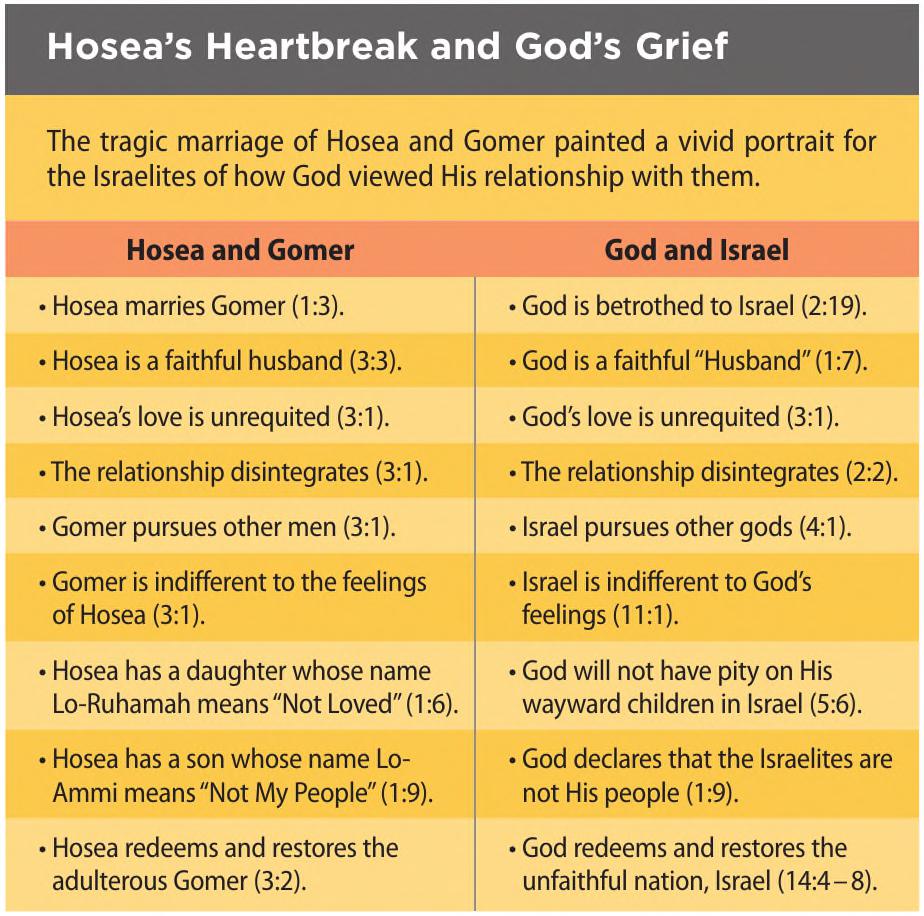
Hosea’s Heartbreak and God’s Grief
The tragic marriage of Hosea and Gomer painted a vivid portrait for
the Israelites of how God viewed His relationship with them.
Hosea and Gomer
God and Israel
• Hosea marries Gomer (1:3).
• God is betrothed to Israel (2:19).
• Hosea is a faithful husband (3:3).
• God is a faithful “Husband” (1:7).
• Hosea’s love is unrequited (3:1).
• God’s love is unrequited (3:1).
• The relationship disintegrates (3:1).
• The relationship disintegrates (2:2).
• Gomer pursues other men (3:1).
• Israel pursues other gods (4:1).
• Gomer is indifferent to the feelings
of Hosea (3:1).
• Israel is indifferent to God’s
feelings (11:1).
• Hosea has a daughter whose name
Lo-Ruhamah means “Not Loved” (1:6).
• God will not have pity on His
wayward children in Israel (5:6).
• Hosea has a son whose name Lo-
Ammi means “Not My People” (1:9).
• God declares that the Israelites are
not His people (1:9).
• Hosea redeems and restores the
adulterous Gomer (3:2).
• God redeems and restores the
unfaithful nation, Israel (14:4 – 8).
Original illustrations
End of source page 1417