PRINTED PAGE 1347NKJV · STUDY EDITION
Daniel INTRODUCTION 1347
years in the future, there is no reason to deny Daniel’s authorship of the book in
the sixth century. The accuracy of its historical information, the form and style of
its Hebrew and Aramaic passages, and the unanimous testimony of ancient tradi-
tion all confirm the witness of the book itself concerning its authorship and date.
Purpose Daniel wrote his book with two purposes in mind. First, he wanted to
assert that the God of Israel was sovereign, even over the powerful nations that
surrounded His people. God’s chosen nation had been conquered and dispersed by
a mighty empire that did not acknowledge God. What would happen now? Would
Babylon’s yoke remain forever on Israel’s shoulders? Would God’s people never
see their homeland again? Had God forgotten His promises? Daniel’s answer was
that Babylon would fall to another empire, which in turn would fall to yet another
great kingdom. History would continue in this pattern until God judged all Gentile
nations and established His everlasting rule. Daniel’s message was obviously meant
to uplift and encourage the weary hearts of the exiled Jews.
Yet Daniel also looked forward to the day when God would restore and reward
Israel. Israel was suffering punishment for its disobedience; but when would the
punishment end? Daniel’s message was both discouraging and encouraging. He
predicted trouble ahead; Israel would suffer under Gentile powers for many years.
But the encouraging news was that the time of trials would also pass away. The
time was coming when God would gather His children to Him again. He would
establish His messianic kingdom which would last forever. The God who directs
the forces of history has not deserted His people. They must continue to trust Him.
His promises of preservation and ultimate restoration are sure.
Christ in the Scriptures
Daniel pictures Jesus as the great Stone who will crush the kingdoms of this world
(2:34, 35, 44). With his love of imagery, the prophet also describes the Messiah as
the Son of Man who is given dominion by the Ancient of Days (7:13, 14). Jesus is
also portrayed as Israel’s Deliverer who will be cut off (9:25, 26).
Daniel’s dreams and visions fill his book. It is quite likely that his vision in 10:5–9
is an appearance of Christ Himself (similar to what the apostle John describes in
Revelation 1:12–16). Daniel’s precise prediction is unlike any other biblical writer’s.
He pinpoints the birth of Jesus five hundred years beforehand. Based on what
Nehemiah tells us (Neh. 2:1–8), the decree about which Daniel writes in 9:25 took
place on March 4, 444 b.c.
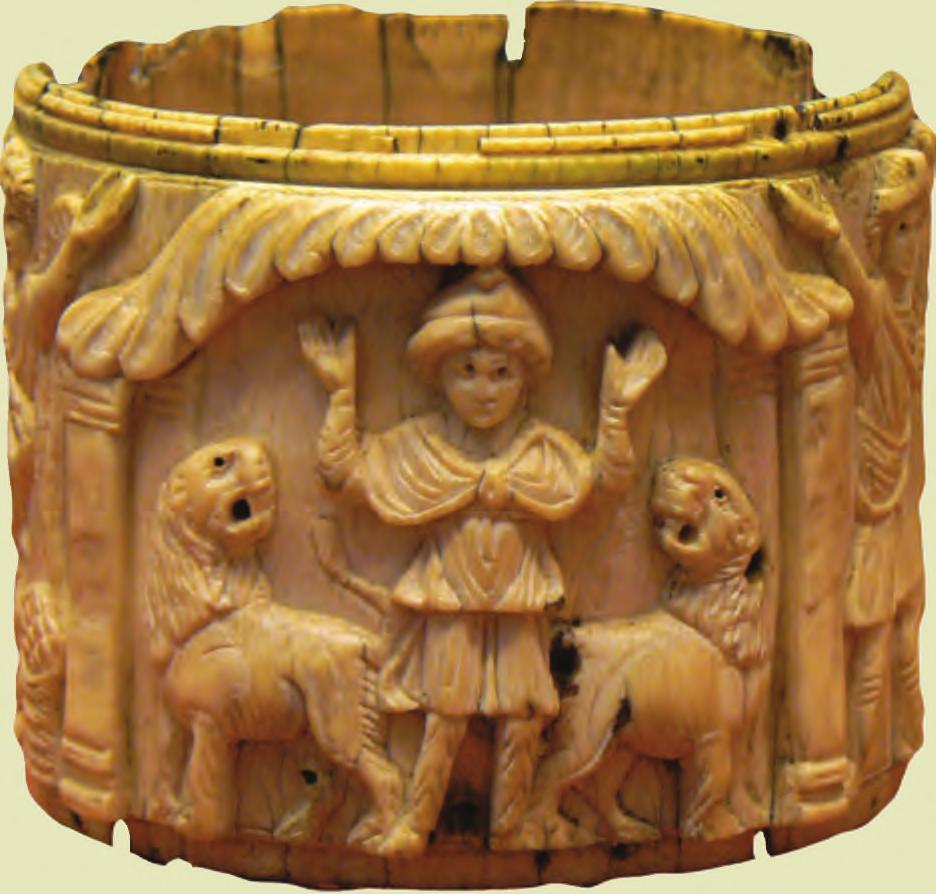
Cup with Daniel surrounded by lions
with angels protecting him (sixth
century b.c.)
Kim Walton, courtesy of the British Museum
612 b.c.
Nineveh falls to
the Medes and
Babylonians
605 b.c.
Nebuchadnezzar
takes Daniel
captive
603 b.c.
Daniel interprets
the king’s dream
586 b.c.
The Babylonians
destroy Jerusalem
c. 580 b.c.
Daniel’s three
friends survive the
fiery furnace
c. 550 b.c.
Belshazzar
assumes the
throne
539 b.c.
Belshazzar’s
kingdom falls to
Cyrus of Persia
538 b.c.
The Jews are
allowed to return
to Jerusalem
c. 537 b.c.
Daniel is thrown
into the lions’ den
Original illustrations
End of source page 1382