PRINTED PAGE 1342NKJV · STUDY EDITION
1342 | Ezekiel 47:15
14 k Gen. 12:7;
13:15; 15:7; 17:8;
26:3; 28:13; Deut.
1:8; Ezek. 20:5, 6,
28, 42 l Ezek. 48:29
15 m Ezek. 48:1
n Num. 34:7, 8
16 o Num. 34:8
p 2 Sam. 8:8
17 q Num. 34:9;
Ezek. 48:1
19 r Num. 20:13;
Deut. 32:51; Ps.
81:7; Ezek. 48:28
5 Heb. Negev 6 Lit.
Strife
21 s Ezek. 45:1
22 t Num. 26:55, 56
u [Eph. 3:6; Rev. 7:9,
10] v [Acts 11:18;
15:9; Gal. 3:28; Eph.
2:12-14; Col. 3:11]
The unilateral and unconditional nature of the Abrahamic covenant
is suggested; this inheritance is a free gift of God’s grace which God’s
people did and could do nothing to deserve.
47:15–17 The northern boundary of the land extends from the Med-
iterranean Sea—the Great Sea—to a border north of Damascus.
The other place names are not certainly known. Damascus is the
capital of Aram (modern Syria). Hamath is thought to have been
north of Damascus, about half the distance to Carchemish. Zedad:
This is believed to have been east of Hamath and Hazar Enan (the
eastern point of this border). Hauran appears to be an Israelite re-
gion east of the Jordan River and north of Gilead.
47:18 The eastern border runs from the Damascus region southwest
through Hauran to and along the Jordan River (see Num. 34:10–12).
eastern . . . sea: The Dead Sea.
47:19 The southern border goes from the eastern side of the Dead
Sea to Tamar (a town to the southwest) to the waters of Meribah
by Kadesh (Num. 20:13, 24; 27:14) along the brook (of Egypt; the
Wadi el-Arish) and on to the Mediterranean Sea (see Num. 34:3–5;
1 Kin. 8:65). This line runs from the Dead Sea southwest across the
Negev to the Brook of Egypt, a river bed in west Sinai.
47:20 The western border runs along the coastline of the Great Sea
(the Mediterranean Sea) north to a point directly west of Hamath
(see Num. 34:6; Rev. 21:1).
47:21–23 The treatment of strangers or aliens in the land is con-
sidered. Non-Israelites who married and settled within the Jewish
communities were to be accepted as native Israelites, qualified to
share in the territorial inheritance of whatever tribe they joined (see
Lev. 19:34; Is. 56:1–8).
19 “The south side, toward the 5 South,
shall be from Tamar to r the waters of
6 Meribah by Kadesh, along the brook to
the Great Sea. This is the south side, to-
ward the South.
20 “The west side shall be the Great Sea,
from the southern boundary until one
comes to a point opposite Hamath. This
is the west side.
21 “Thus you shall s divide this land
among yourselves according to the tribes
of Israel. 22 It shall be that you will divide
it by t lot as an inheritance for yourselves,
u and for the strangers who dwell among
you and who bear children among you.
v They shall be to you as native-born
among the children of Israel; they shall
have an inheritance with you among the
tribes of Israel. 23 And it shall be that in
whatever tribe the stranger dwells, there
you shall give him his inheritance,” says
the Lord GOD.
equally with one another; for I k raised
My hand in an oath to give it to your fa-
thers, and this land shall l fall to you as
your inheritance.
15 “This shall be the border of the land
on the north: from the Great Sea, by m the
road to Hethlon, as one goes to n Zedad,
16 o Hamath, p Berothah, Sibraim (which
is between the border of Damascus and
the border of Hamath), to Hazar Hatti
con (which is on the border of Hauran).
17 Thus the boundary shall be from the
Sea to q Hazar Enan, the border of Da
mascus; and as for the north, northward,
it is the border of Hamath. This is the
north side.
18 “On the east side you shall mark out
the border from between Hauran and Da
mascus, and between Gilead and the land
of Israel, along the Jordan, and along the
eastern side of the sea. This is the east
side.
Bible Times & Culture Notes
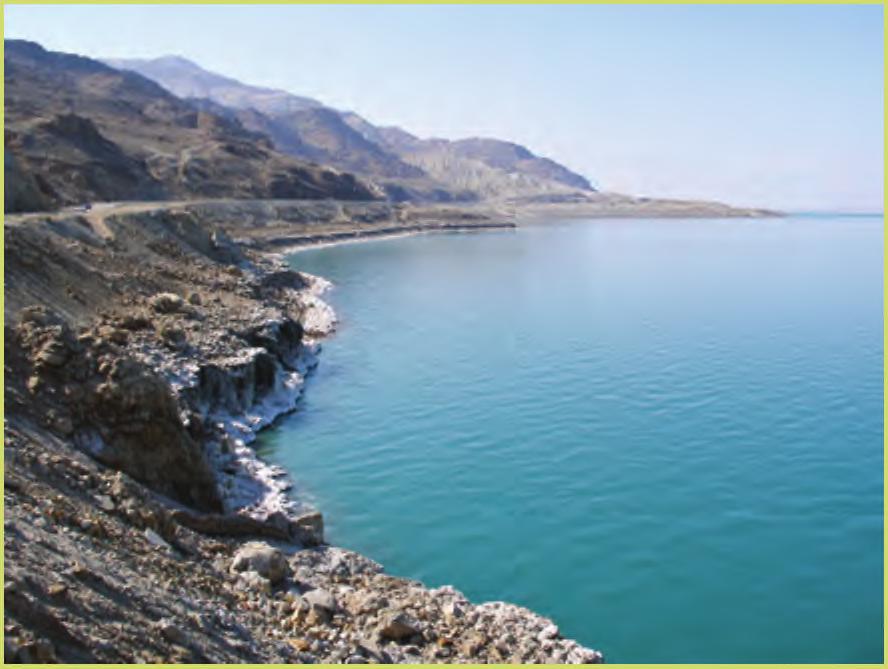
The Dead Sea
The lowest body of water in the world is the
Dead Sea. Fifty miles in length, it does not
measure more than 11 miles at the widest. The
water surface of the Dead Sea is about thirteen
hundred feet below sea level. Its depth has
been estimated at another thirteen hundred
feet. Because the sea has no outlet and evap-
oration is high, the concentration of minerals is
as much as 30 percent. The water abounds with
salt, bromide, magnesium chloride, potassium
chloride, and sulfur.
The Dead Sea region is aptly named. Even
fish struggle against being carried into the sea,
for its high mineral content brings immediate
death. The prophet Ezekiel envisioned the res-
toration of the Dead Sea valley. In his vision,
water poured forth from the temple altar and
flowed into the Kidron through the Judean wil-
derness to the Dead Sea (47:8–12). Revelation
22:1–5 tells of a strikingly similar vision.
Salt along the shore of the Dead Sea
Gusjer/Flickr, CC-BY 2.0
Original illustrations
End of source page 1377