PRINTED PAGE 99NKJV · STUDY EDITION
Exodus 5:2 | 99
did the signs in the sight of the people.
31 So the people p believed; and when they
heard that the LORD had q visited the chil-
dren of Israel and that He r had looked on
their affliction, then s they bowed their
heads and worshiped.
First Encounter with Pharaoh
5
Afterward Moses and Aaron went
in and told Pharaoh, “Thus says the
LORD God of Israel: ‘Let My people go,
that they may 1 hold a a feast to Me in the
wilderness.’ ”
2 And Pharaoh said, b “Who is the
LORD, that I should obey His voice to let
25 Then h Zipporah took i a sharp stone and
cut off the foreskin of her son and 3 cast it
at 4 Moses’ feet, and said, “Surely you are a
husband of blood to me!” 26 So He let him
go. Then she said, “You are a 5 husband
of blood!”—because of the circumcision.
27 And the LORD said to Aaron, “Go
into the wilderness j to meet Moses.” So
he went and met him on k the mountain
of God, and kissed him. 28 So Moses l told
Aaron all the words of the LORD who
had sent him, and all the m signs which
He had commanded him. 29 Then Moses
and Aaron n went and gathered together
all the elders of the children of Israel.
30 o And Aaron spoke all the words which
the LORD had spoken to Moses. Then he
circumcising male infants.) Moses’ neglect was a crime deserving
of death, especially for the future leader of God’s people. For this
reason God met or “seized” Moses (for another use of this same
Hebrew verb, see v. 27).
4:25, 26 At this time, circumcision was practiced with stone knives
rather than bronze because of associations with ancient traditions
that may even have predated Israelite circumcision (see Gen. 17).
Many of Israel’s neighboring peoples practiced circumcision, but
none except Israel circumcised infants. husband of blood: Zippo-
rah may have been angry that she could not follow the Midianite
custom and leave her son uncircumcised.
4:26 The Lord who had met or “seized” Moses (v. 24), now let
him go.
4:27, 28 The meeting of these two brothers after 40 years must have
been a very emotional moment. The Hebrew verb translated met
encompasses the idea of a forceful, direct encounter—a bear hug
(this same Hebrew verb is used in v. 24). How fitting that the two
would meet on the mountain of God (3:1). Later at this mountain
they would both minister together.
4:29–31 When they arrived in Egypt, they gathered the elders to-
gether. Aaron acted as Moses’ prophet (vv. 14–16). It is not clear
whether it was Aaron or Moses who did the signs. But the people’s
response was appropriate. They believed and worshiped the God
who had sent these signs and messengers. God had visited them!
Here God’s visitation is for deliverance (as in Ruth 1:6). In other places
the word refers to a visitation in wrath (as in Is. 10:12).
5:1 God emboldened Moses and Aaron to approach the powerful
tyrant of Egypt with strong, daring words in the name of their God:
“Let My people go.” Yet the Lord told them what to expect (3:19;
4:21–23). It was God’s plan that Pharaoh would not agree to their
demand.
5:2 Who is the Lord: Later these arrogant words would haunt
Pharaoh (12:31, 32). Indeed he would ascribe greatness to God and
shamefulness to himself and his people (9:27). Meanwhile, Pharaoh
believed himself to be a god. He certainly felt no need to cave in to
the demands of some other, unknown god. Sadly for him, he had
never encountered the true and living God, hence his response, nor
will I let Israel go, just as God had predicted (3:19; 4:21–23). Note
2 Chr. 32:14; Job 21:15
25 h Ex. 2:21; 18:2
i Gen. 17:14; Josh.
5:2, 3 3 Lit. made it
touch 4 Lit. his
26 5 bridegroom
27 j Ex. 4:14 k Ex.
3:1; 18:5; 24:13
28 l Ex. 4:15, 16
m Ex. 4:8, 9
29 n Ex. 3:16; 12:21
30 o Ex. 4:15, 16
31 p Ex. 3:18; 4:8, 9;
19:9 q Gen. 50:24;
Ex. 3:16 r Ex. 2:25;
3:7 s Gen. 24:26; Ex.
12:27; 1 Chr. 29:20
CHAPTER 5
1 a Ex. 3:18; 7:16;
10:9 1 keep a
pilgrim-feast
2 b 2 Kin. 18:35;
Bible Times & Culture Notes
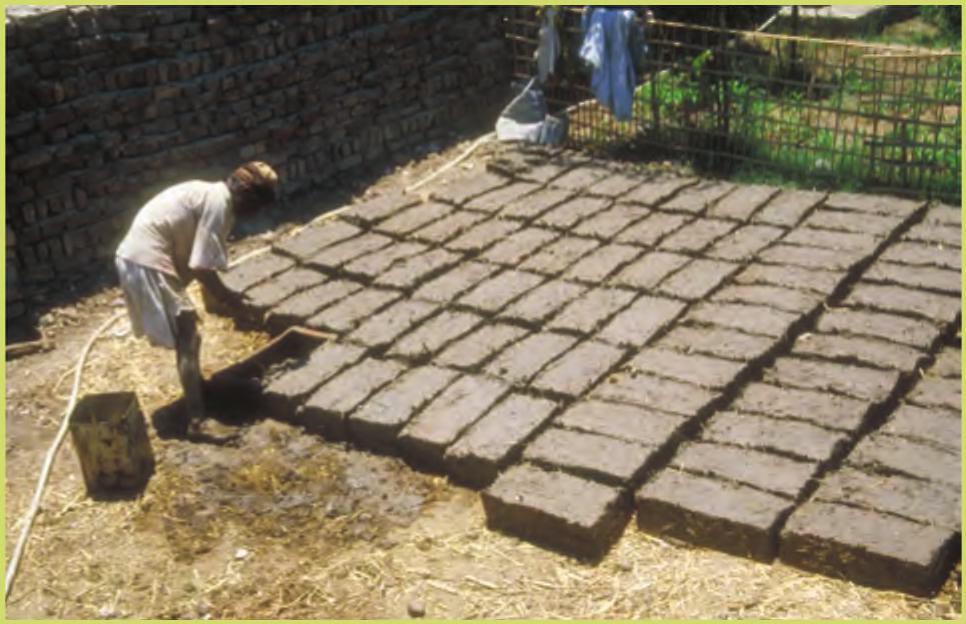
Bricks
Bricks were common building materials
in the ancient world. They were usually
rectangular in shape and composed of
clay or mud, along with other ingredients
such as straw (5:7–9) or sand. Bricks were
usually baked by the sun, but they could
also be fired in a kiln to produce greater
strength and hardness.
The earliest bricks were shaped
by hand; later, they were formed with
wooden molds. Brickmaking involved
several stages. A good clay source was
absolutely necessary; then the clay was
sifted and mixed to the desired consis-
tency by adding water. Generally, a tem-
per, often straw, was added; this temper
acted as a binder for poor clays and pre-
vented warping and cracking during the
drying process. Following this, the bricks
were shaped and then dried. Bricks were
often inscribed with an official’s name,
the name of a building, or a dedicatory
inscription.
An Egyptian man makes mud bricks as the ancient Israelites would have
done. Note the brick mold at the man’s feet.
© 1995 by Phoenix Data Systems
Original illustrations
End of source page 134