PRINTED PAGE 1237NKJV · STUDY EDITION
Jeremiah 46:24 | 1237
46:13 This verse is a prose introduction to a poetic description of
Nebuchadnezzar’s attack on Egypt. After the battle at Carchemish,
the Babylonian march through Palestine was resumed in 604 b.c.
They attacked Ashkelon and then pursued the Egyptians.
46:14–17 Why are your valiant men swept away: The fall of the
gods before God in judgment is a prominent theme in the oracles
against the nations (v. 25). the Lord drove them: Babylon is de-
picted as the instrument of God’s judgment.
46:18, 19 King . . . Lord of hosts: The term hosts can also be trans-
lated “armies.” God is the true and sovereign King over all the armies
of heaven and earth. Tabor . . . Carmel: The mountains stand for
the certainty of God’s kingship. Like Judah, Egypt would face God’s
destructive judgment.
46:20–24 Egypt’s destroyer invaded from the north, the same
direction from which Judah’s adversary attacked. fat bulls: Egypt’s
well-paid mercenaries were frail before God and the Babylonians,
who came like lumberjacks cutting down the forest and chopping
the fleeing serpents, the Egyptians. Egypt’s demise is parallel to
Israel’s; the virgin daughter had been violated and stood ashamed
(2:26), soon to be taken captive by Babylon.
13 r Is. 19:1; Jer.
43:10, 11; Ezek.
29:1-21
14 s Jer. 44:1 t Ezek.
30:18 6 Ancient
Memphis
16 u Lev. 26:36, 37;
Jer. 46:6 v Jer. 51:9
18 w Is. 47:4; Jer.
48:15; Mal. 1:14
19 x Jer. 48:18 y Is.
20:4 7 Ancient
Memphis
20 z Hos. 10:11
a Jer. 1:14
21 8 Lit. calves of
the stall
b [Ps. 37:13]; Jer. 50:27
22 c [Is. 29:4]
23 d Is. 10:34
e Judg. 6:5; 7:12;
Joel 2:25
24 f Jer. 1:15
For b the day of their calamity had
come upon them,
The time of their punishment.
22 c Her noise shall go like a serpent,
For they shall march with an
army
And come against her with axes,
Like those who chop wood.
23 “ They shall d cut down her forest,”
says the LORD,
“ Though it cannot be searched,
Because they are innumerable,
And more numerous than
e grasshoppers.
24 The daughter of Egypt shall be
ashamed;
She shall be delivered into the hand
Of f the people of the north.”
Babylonia Will Strike Egypt
13 The word that the LORD spoke to Jer
emiah the prophet, how Nebuchadnezzar
king of Babylon would come and r strike
the land of Egypt.
14 “ Declare in Egypt, and proclaim in
s Migdol;
Proclaim in 6 Noph and in
t Tahpanhes;
Say, ‘Stand fast and prepare
yourselves,
For the sword devours all around
you.’
15 Why are your valiant men swept
away?
They did not stand
Because the LORD drove them
away.
16 He made many fall;
Yes, u one fell upon another.
And they said, ‘Arise!
v Let us go back to our own people
And to the land of our nativity
From the oppressing sword.’
17 They cried there,
‘ Pharaoh, king of Egypt, is but a
noise.
He has passed by the appointed
time!’
18 “ As I live,” says the King,
w Whose name is the LORD of hosts,
“ Surely as Tabor is among the
mountains
And as Carmel by the sea, so he shall
come.
19 O x you daughter dwelling in
Egypt,
Prepare yourself y to go into
captivity!
For 7 Noph shall be waste and
desolate, without inhabitant.
20 “ Egypt is a very pretty z heifer,
But destruction comes, it comes
a from the north.
21 Also her mercenaries are in her
midst like 8 fat bulls,
For they also are turned back,
They have fled away together.
They did not stand,
Bible Times & Culture Notes
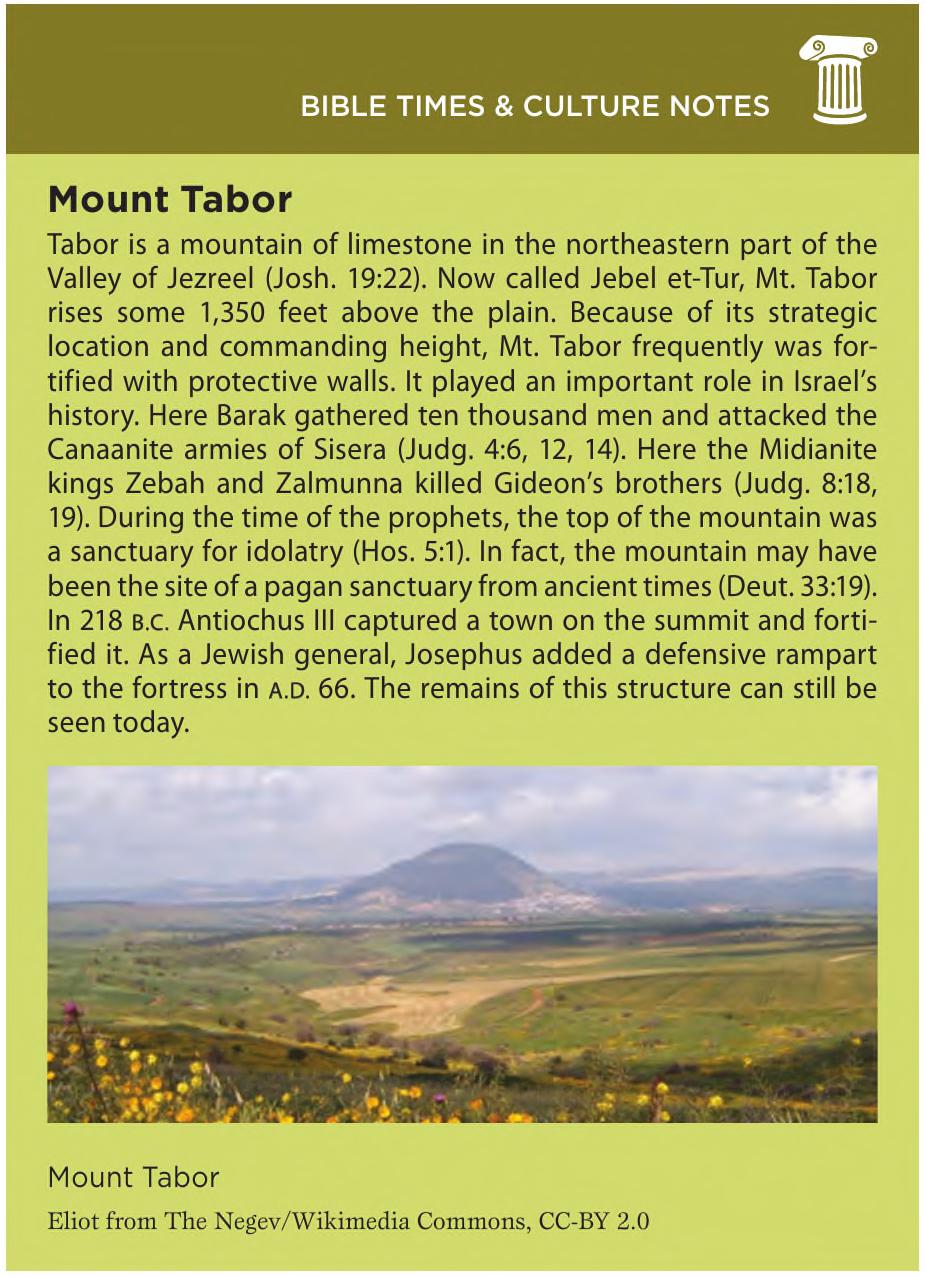
Mount Tabor
Tabor is a mountain of limestone in the northeastern part of the
Valley of Jezreel (Josh. 19:22). Now called Jebel et-Tur, Mt. Tabor
rises some 1,350 feet above the plain. Because of its strategic
location and commanding height, Mt. Tabor frequently was for-
tified with protective walls. It played an important role in Israel’s
history. Here Barak gathered ten thousand men and attacked the
Canaanite armies of Sisera (Judg. 4:6, 12, 14). Here the Midianite
kings Zebah and Zalmunna killed Gideon’s brothers (Judg. 8:18,
19). During the time of the prophets, the top of the mountain was
a sanctuary for idolatry (Hos. 5:1). In fact, the mountain may have
been the site of a pagan sanctuary from ancient times (Deut. 33:19).
In 218 b.c. Antiochus III captured a town on the summit and forti-
fied it. As a Jewish general, Josephus added a defensive rampart
to the fortress in a.d. 66. The remains of this structure can still be
seen today.
Mount Tabor
Eliot from The Negev/Wikimedia Commons, CC-BY 2.0
Original illustrations
End of source page 1272