PRINTED PAGE 1223NKJV · STUDY EDITION
Jeremiah 35:5 | 1223
34:17 Because the leaders of Judah had disobeyed the covenant
by revoking the liberty granted to Hebrew slaves (v. 11), the Lord
declared that He would grant liberty to the leaders—liberty from
their disobedience and liberty to the sword, to pestilence, and
to famine.
34:18, 19 The covenant ceremony is outlined. The main ritual of the
two-party covenant began with cutting the sacrificial animal in half,
after which the two participants would walk together between the
parts (see Gen. 15). The divided animal portrayed the potential fate
of one who broke the covenant stipulations.
34:20 I will give them into the hand of their enemies: The
slaves who had been wronged by the leaders of Judah would be
vindicated by God, using the Babylonian army as His instrument.
34:21, 22 gone back: Nebuchadnezzar had withdrawn from Je-
rusalem to meet the Egyptian army of Pharaoh Hophra. Zedekiah
had hopes that Hophra would be successful in delivering Israel from
its impending doom. However, Nebuchadnezzar soon renewed the
siege of Jerusalem and destroyed the city.
35:1 in the days of Jehoiakim: Jehoiakim reigned from 609 to
598 b.c.
35:2 The Rechabites were a tightly knit group of descendants of
the Kenites (see Judg. 1:16; 1 Chr. 2:55). This group is known first
from the story of Jehonadab the son of Rechab, who assisted Jehu
in purging the Baal prophets from Samaria (see 2 Kin. 10:15–28).
The Rechabites lived as nomads, rejecting all forms of urban and
agrarian life. They refused to drink wine or strong drink and would
not cultivate vineyards. They also would not plant any other crops.
Many scholars believe that they were a clan of metalsmiths. The
Rechabites were invited by Jeremiah into one of the chambers
surrounding the courtyard of the temple of God for a symbolic
demonstration.
35:3–5 Man of God refers to a number of named and unnamed
prophets, emissaries from God who delivered specific messages
(see 1 Sam. 2:27; 1 Kin. 12:22; 13:1; 2 Kin. 1:9). Hanan was apparently
sympathetic to Jeremiah’s preaching. In the temple and in the pres-
ence of leading temple personnel, Jeremiah tested the Rechabites’
faithfulness to their tradition by putting wine in front of them and
telling them to drink.
hoiakim the son of Josiah, king of Judah,
saying, 2 “Go to the house of the a Rechab
ites, speak to them, and bring them into
the house of the LORD, into one of b the
chambers, and give them wine to drink.”
3 Then I took Jaazaniah the son of
Jeremiah, the son of Habazziniah, his
brothers and all his sons, and the whole
house of the Rechabites, 4 and I brought
them into the house of the LORD, into the
chamber of the sons of Hanan the son of
Igdaliah, a man of God, which was by the
chamber of the princes, above the cham-
ber of Maaseiah the son of Shallum, c the
keeper of the 1 door. 5 Then I set before
the sons of the house of the Rechabites
bowls full of wine, and cups; and I said
to them, “Drink wine.”
the house which is called by My name.
16 Then you turned around and r profaned
My name, and every one of you brought
back his male and female slaves, whom
you had set at liberty, at their pleasure,
and brought them back into subjection,
to be your male and female slaves.’
17 “Therefore thus says the LORD: ‘You
have not obeyed Me in proclaiming lib-
erty, every one to his brother and every
one to his neighbor. s Behold, I proclaim
liberty to you,’ says the LORD—t ‘to the
sword, to pestilence, and to famine! And
I will deliver you to u trouble among all
the kingdoms of the earth. 18 And I will
give the men who have transgressed
My covenant, who have not performed
the words of the covenant which they
made before Me, when v they cut the calf
in two and passed between the parts of
it— 19 the princes of Judah, the princes
of Jerusalem, the 4 eunuchs, the priests,
and all the people of the land who passed
between the parts of the calf— 20 I will
w give them into the hand of their en-
emies and into the hand of those who
seek their life. Their x dead bodies shall
be for meat for the birds of the heav-
en and the beasts of the earth. 21 And I
will give Zedekiah king of Judah and his
princes into the hand of their enemies,
into the hand of those who seek their
life, and into the hand of the king of Bab
ylon’s army y which has gone back from
you. 22 z Behold, I will command,’ says the
LORD, ‘and cause them to return to this
city. They will fight against it a and take
it and burn it with fire; and b I will make
the cities of Judah a desolation without
inhabitant.’ ”
The Obedient Rechabites
35
The word which came to Jeremiah
from the LORD in the days of Je
16 r Ex. 20:7; Lev.
19:12
17 s Lev. 26:34, 35;
Esth. 7:10; Dan.
6:24; [Matt. 7:2;
Gal. 6:7]; James
2:13 t Jer. 32:24, 36
u Deut. 28:25, 64;
Jer. 29:18
18 v Gen. 15:10, 17
19 4 Or officers
20 w 2 Kin. 25:19-21;
Jer. 22:25 x Deut.
28:26; 1 Sam. 17:44,
46; 1 Kin. 14:11;
16:4; Ps. 79:2; Jer.
7:33; 16:4; 19:7
21 y Jer. 37:5-11;
39:4-7
22 z Jer. 37:8, 10
a Jer. 38:3; 39:1, 2, 8;
52:7, 13 b Jer. 9:11;
44:2, 6
CHAPTER 35
2 a 2 Sam. 4:2;
2 Kin. 10:15; 1 Chr.
2:55 b 1 Kin. 6:5, 8;
1 Chr. 9:26, 33
4 c 2 Kin. 12:9;
25:18; 1 Chr. 9:18, 19
1 Lit. threshold
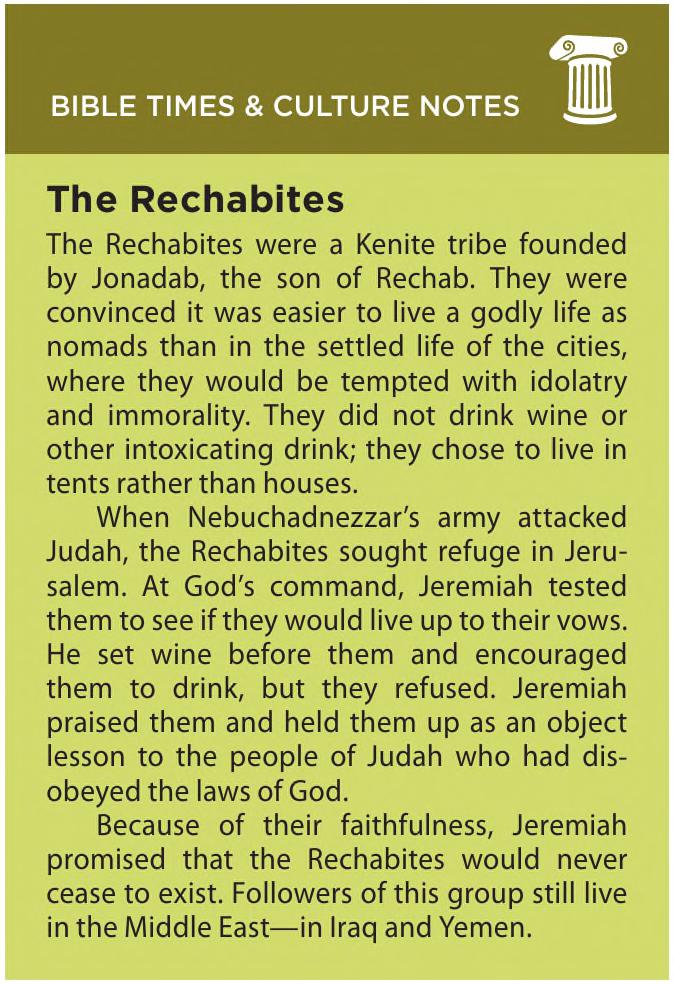
Bible Times & Culture Notes
The Rechabites
The Rechabites were a Kenite tribe founded
by Jonadab, the son of Rechab. They were
convinced it was easier to live a godly life as
nomads than in the settled life of the cities,
where they would be tempted with idolatry
and immorality. They did not drink wine or
other intoxicating drink; they chose to live in
tents rather than houses.
When Nebuchadnezzar’s army attacked
Judah, the Rechabites sought refuge in Jeru
salem. At God’s command, Jeremiah tested
them to see if they would live up to their vows.
He set wine before them and encouraged
them to drink, but they refused. Jeremiah
praised them and held them up as an object
lesson to the people of Judah who had dis-
obeyed the laws of God.
Because of their faithfulness, Jeremiah
promised that the Rechabites would never
cease to exist. Followers of this group still live
in the Middle East—in Iraq and Yemen.
Original illustrations
End of source page 1258