PRINTED PAGE 1198NKJV · STUDY EDITION
1198 | Jeremiah 20:16
20:16, 17 Jeremiah’s intense dejection caused him to call for the
death of the man who told Jeremiah’s father the good news of his
son’s birth. did not relent: Jeremiah, in his distress, thought it
would have been more merciful for him to die before birth than to
endure the hardship of rejection, persecution, and imprisonment
that he faced.
21:1 Pashhur the son of Melchiah had Jeremiah cast into a dun-
geon for the prophet’s alleged disloyalty to the kingdom (38:1–6).
Zephaniah the son of Maaseiah was a temple officer who, with
others, sought divine guidance through Jeremiah’s counsel (37:3, 4).
21:2 To inquire of the Lord means to seek His will. Nebuchadnez-
zar was king of Babylon from 605–562 b.c. wonderful works: This
phrase is primarily used of God in His cosmic activity and mighty acts
in history on behalf of Israel (see Ps. 40:5). God had delivered Jerusa-
lem from destruction during the siege of Sennacherib of Assyria in
701 b.c.; King Zedekiah was hoping for a similar divine deliverance.
21:3, 4 Jeremiah’s response to Zedekiah was demoralizing. Instead
of turning back the forces of the Babylonians, God would thwart
what little strength Jerusalem could muster against them.
21:5 Because the people of Judah had become God’s enemies, God
would fight against them. outstretched hand . . . strong arm:
The divine instruments by which Israel had gained freedom from
Egypt (see Ex. 15:6; Deut. 6:21) and deliverance from their enemies
would be used against them.
21:6, 7 The pestilence that would strike man and beast recalls
one of God’s plagues on the Egyptians prior to the Exodus (see Ex.
9:1–7). Nebuchadnezzar . . . enemies . . . those who seek their
life: Not only did the Babylonians inflict damage upon Judah, so did
constant enemies like the Edomites, who raided and then settled in
the dry regions to the south. God would not spare or have pity on
the stubborn and rebellious inhabitants of Judah and Jerusalem.
21:8, 9 way of life . . . way of death: Death would come to those
who attempted to survive the siege of Jerusalem; life was possible
through surrender to the Chaldeans (Babylonians). Prize usually
refers to the booty and spoils of war. Those who submitted to the
Babylonians were on the side of God, and their “booty” would be
their lives (38:2).
21:10 I have set My face: This phrase describes the fixed inten-
Zedekiah king of Judah, his servants and
the people, and such as are left in this city
from the pestilence and the sword and the
famine, into the hand of Nebuchadnezzar
king of Babylon, into the hand of their
enemies, and into the hand of those who
seek their life; and he shall strike them
with the edge of the sword. i He shall not
spare them, or have pity or mercy.” ’
8 “Now you shall say to this people,
‘Thus says the LORD: “Behold, j I set be-
fore you the way of life and the way of
death. 9 He who k remains in this city
shall die by the sword, by famine, and by
pestilence; but he who goes out and 3 de
fects to the Chaldeans who besiege you,
he shall l live, and his life shall be as a
prize to him. 10 For I have m set My face
“ A male child has been born to you!”
Making him very glad.
16 And let that man be like the cities
Which the LORD v overthrew, and did
not relent;
Let him w hear the cry in the morning
And the shouting at noon,
17 x Because he did not kill me from the
womb,
That my mother might have been my
grave,
And her womb always enlarged
with me.
18 y Why did I come forth from the womb
to z see 6 labor and sorrow,
That my days should be consumed
with shame?
Jerusalem’s Doom Is Sealed
21
The word which came to Jere
miah from the LORD when a King
Zedekiah sent to him b Pashhur the son
of Melchiah, and c Zephaniah the son of
Maaseiah, the priest, saying, 2 d “Please
inquire of the LORD for us, for 1 Nebu
chadnezzar king of Babylon makes war
against us. Perhaps the LORD will deal
with us according to all His wonder-
ful works, that the king may go away
from us.”
3 Then Jeremiah said to them, “Thus
you shall say to Zedekiah, 4 ‘Thus says
the LORD God of Israel: “Behold, I will
turn back the weapons of war that are in
your hands, with which you fight against
the king of Babylon and the 2 Chaldeans
who besiege you outside the walls; and e I
will assemble them in the midst of this
city. 5 I f Myself will fight against you
with an g outstretched hand and with a
strong arm, even in anger and fury and
great wrath. 6 I will strike the inhabitants
of this city, both man and beast; they
shall die of a great pestilence. 7 And after
ward,” says the LORD, h “I will deliver
16 v Gen. 19:25
w Jer. 18:22
17 x Job 3:10, 11
18 y Job 3:20; Jer.
15:10 z Lam. 3:1
6 toil
CHAPTER 21
1 a 2 Kin. 24:17, 18;
Jer. 32:1-3; 37:1;
52:1-3 b 1 Chr. 9:12;
Jer. 38:1 c 2 Kin.
25:18; Jer. 29:25;
37:3
2 d Ex. 9:28;
1 Sam. 9:9; Jer.
37:3, 7; Ezek. 14:7;
20:1-3 1 Heb.
Nebuchadrezzar,
and so elsewhere
in the book
4 e Is. 13:4; Jer.
39:3; Lam. 2:5, 7;
Zech. 14:2 2 Or
Babylonians, and
so elsewhere in the
book
5 f Jer. 32:24; 33:5;
Is. 63:10 g Ex. 6:6;
Deut. 4:34; Jer. 6:12
7 h 2 Kin. 25:5-7,
18-21; Jer. 37:17;
39:5; 52:9
i Deut. 28:50; 2 Chr.
36:17; Jer. 13:14;
Ezek. 7:9; Hab.
1:6-10
8 j Deut. 30:15, 19;
Is. 1:19, 20
9 k Jer. 38:2 l Jer.
39:18 3 Lit. falls
away to
10 m Lev. 17:10; Jer.
44:11, 27; Amos 9:4
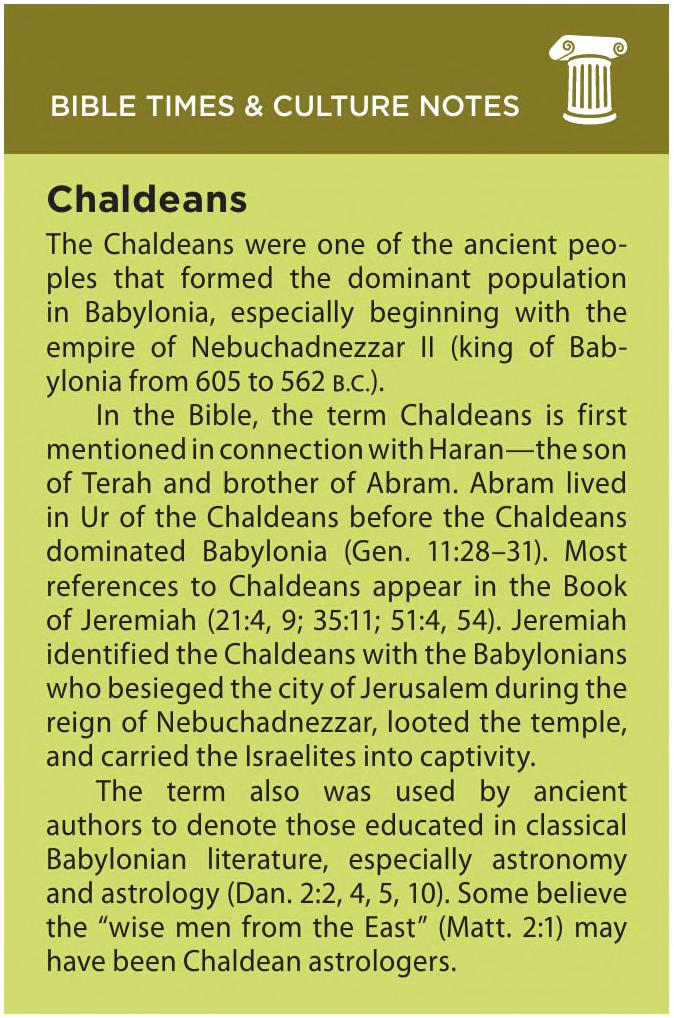
Bible Times & Culture Notes
Chaldeans
The Chaldeans were one of the ancient peo-
ples that formed the dominant population
in Babylonia, especially beginning with the
empire of Nebuchadnezzar II (king of Bab
ylonia from 605 to 562 b.c.).
In the Bible, the term Chaldeans is first
mentioned in connection with Haran—the son
of Terah and brother of Abram. Abram lived
in Ur of the Chaldeans before the Chaldeans
dominated Babylonia (Gen. 11:28–31). Most
references to Chaldeans appear in the Book
of Jeremiah (21:4, 9; 35:11; 51:4, 54). Jeremiah
identified the Chaldeans with the Babylonians
who besieged the city of Jerusalem during the
reign of Nebuchadnezzar, looted the temple,
and carried the Israelites into captivity.
The term also was used by ancient
authors to denote those educated in classical
Babylonian literature, especially astronomy
and astrology (Dan. 2:2, 4, 5, 10). Some believe
the “wise men from the East” (Matt. 2:1) may
have been Chaldean astrologers.
Original illustrations
End of source page 1233