PRINTED PAGE 1196NKJV · STUDY EDITION
1196 | Jeremiah 19:14
20:1 Pashhur . . . chief governor: A person in this position had
to be a priest. He had oversight of the temple, the temple guards,
entry into the courts, and so on. Jeremiah’s proclamations against
the city and the temple were of grave concern to Pashhur because
of the threat to the continuation of the cult in which he was involved.
20:2 Jeremiah was beaten and confined to a stockade by Pashhur.
This was not a normal prison or dungeon, but a holding cell for those
who might defile the area by uncleanness or aberrant behavior.
The high gate of Benjamin was also called the Upper Gate, to
distinguish it from another city gate of the same name. This portal
provided access into the temple courtyards from the north, the di-
rection of Benjamin’s territory.
20:3, 4 The name Magor-Missabib means “Terror on Every Side.”
As Pashhur had been a terror to Jeremiah, so he would become
a terror to himself, his family, and his associates. The foe from the
north described in earlier passages (1:13–15) is here identified as
Babylon.
20:5 The four resources of Jerusalem that would be transported
with the exiles to Babylon were wealth, produce, precious
things, and treasures. This list is balanced by four terms for the
and put him in the stocks that were in the
high c gate of Benjamin, which was by the
house of the LORD.
3 And it happened on the next day that
Pashhur brought Jeremiah out of the
stocks. Then Jeremiah said to him, “The
LORD has not called your name Pashhur,
but 1 Magor-Missabib. 4 For thus says the
LORD: ‘Behold, I will make you a terror to
yourself and to all your friends; and they
shall fall by the sword of their enemies,
and your eyes shall see it. I will d give all
Judah into the hand of the king of Bab
ylon, and he shall carry them captive to
Babylon and slay them with the sword.
5 Moreover I e will deliver all the wealth
of this city, all its produce, and all its pre-
cious things; all the treasures of the kings
14 Then Jeremiah came from Tophet,
where the LORD had sent him to proph-
esy; and he stood in s the court of the
Lord’s house and said to all the people,
15 “Thus says the LORD of hosts, the God
of Israel: ‘Behold, I will bring on this city
and on all her towns all the doom that
I have pronounced against it, because
t they have stiffened their necks that they
might not hear My words.’ ”
The Word of God to Pashhur
20
Now a Pashhur the son of b Immer,
the priest who was also chief gov-
ernor in the house of the LORD, heard that
Jeremiah prophesied these things. 2 Then
Pashhur struck Jeremiah the prophet,
14 s 2 Chr. 20:5; Jer.
26:2-8
15 t Neh. 9:17, 29;
Jer. 7:26; 17:23
CHAPTER 20
1 a Ezra 2:37, 38
b 1 Chr. 24:14
2 c Jer. 37:13; Zech.
14:10
3 1 Lit. Fear on Every
Side
4 d Jer. 21:4-10
5 e 2 Kin. 20:17;
2 Chr. 36:10; Jer.
3:24; 27:21, 22
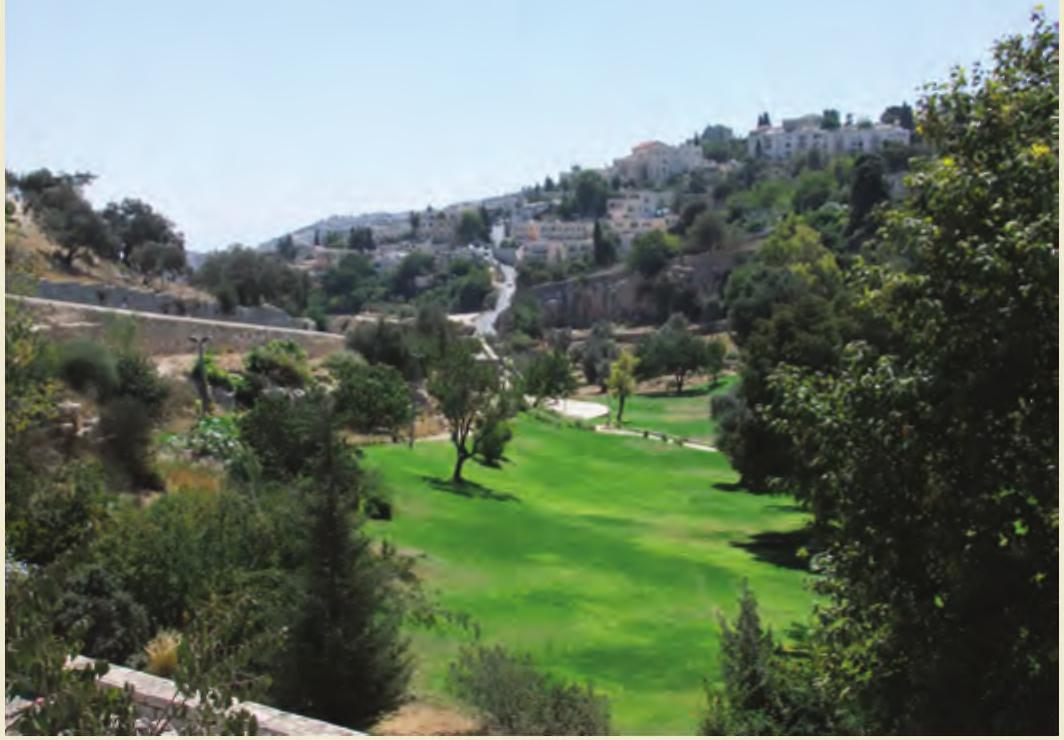
The Valley of Hinnom
Dror Feitelson Pikiwiki Israel/Wikimedia Commons, CC-BY 2.5
The Valley of Slaughter
A deep, narrow ravine south of Jebus (later Jerusalem), called the Valley of Hinnom or the Valley of the Son of Hinnom,
was the boundary between the territories of Benjamin and Judah (Josh. 15:8; 18:16). The location was unremarkable in
Joshua’s day, but came to have great significance later in Israelite history.
In the period of the divided monarchy, this valley was the site of a pagan altar (see Deut. 12:2) known as Tophet
(“fireplace”; Jer. 7:31, 32; 19:6, 11–14). Parents sacrificed their children there to the god Molech. The Bible singles out Ahaz
and Manasseh, kings of Judah, as having led the way in this grotesque ritual (2 Chr. 28:3; 33:6). But Scripture praises King
Josiah for destroying this idolatrous altar during his reforms (2 Kin. 23:10).
Jeremiah, who was called as a
prophet during Josiah’s reign, foretold
that God would judge the Israelites for
committing the awful abomination of
human sacrifice, among other evils.
The Lord would cause such destruc-
tion that the Valley of Hinnom would
become a cemetery known as the Val-
ley of Slaughter (Jer. 7:32; 19:6).
This prophecy began to be fulfilled
when Jerusalem was destroyed by the
Babylonians in 586 b.c. Later, the valley
became the city dump for Jerusalem.
Fires continually smoldered there, as
the site was used as a burning ground
for refuse and the dead bodies of crim-
inals and animals.
In time, the valley became so nox-
ious that its name became a synonym
for hell. The Hebrew phrase ge (“valley
of”) hinnom eventually became the
Greek gehenna, translated as “hell fire”
(Matt. 5:22; Mark 9:43, 45, 47). At one
time, Jewish tradition even held that
the entrance to hell began at that valley.
Original illustrations
End of source page 1231