PRINTED PAGE 1175NKJV · STUDY EDITION
Jeremiah 7:20 | 1175
7:13 All these works are the sins listed in vv. 6, 8, 9.
7:14, 15 The earlier dwelling place of the ark of God, Shiloh, served
as an example of the impending destruction of Jerusalem. The tem-
ple had to be destroyed to vindicate the name of God; the people
had to be removed from the land in order to purge it of wickedness.
7:16 God’s instruction to Jeremiah, do not pray for this people,
indicates the extreme depravity of Jerusalem’s inhabitants (see also
11:14; 14:11). No manner of intercession was to be made on behalf
of Judah. God would not hear Jeremiah’s appeals.
7:17, 18 The queen of heaven refers to the goddess Ishtar (As-
tarte), who was worshiped in open-air cultic centers throughout the
eastern Mediterranean region and Mesopotamia. Worship of Ishtar
involved the preparation of special cakes that bore the goddess’s
image, as well as drink offerings (44:19). The family cooperation
in the idolatrous worship of Ishtar stood in direct opposition to the
covenant demands that a father instruct his children in the ways of
the Lord (see Deut. 6:4–9).
7:19 Provoke, which means “to vex or irritate,” describes the effects
of Israel’s continual unfaithfulness on God. Furthermore, they were
bringing harm upon themselves.
7:20 God’s judgment on the abominable idolatry of Ishtar worship
is described in terms of a fire that cannot be quenched. The dev-
astation of the fire would extend to man, beast, field, and fruit.
not hear you. 17 Do you not see what they
do in the cities of Judah and in the streets
of Jerusalem? 18 y The children gather
wood, the fathers kindle the fire, and the
women knead dough, to make cakes for
the queen of heaven; and they z pour out
drink offerings to other gods, that they
may provoke Me to anger. 19 a Do they
provoke Me to anger?” says the LORD.
“Do they not provoke themselves, to the
shame of their own faces?”
20 Therefore thus says the Lord GOD:
“Behold, My anger and My fury will be
poured out on this place—on man and on
beast, on the trees of the field and on the
fruit of the ground. And it will burn and
not be quenched.”
first, and see q what I did to it because
of the wickedness of My people Israel.
13 And now, because you have done all
these works,” says the LORD, “and I spoke
to you, r rising up early and speaking, but
you did not hear, and I s called you, but
you did not answer, 14 therefore I will do
to the house which is called by My name,
in which you trust, and to this place
which I gave to you and your fathers, as
I have done to t Shiloh. 15 And I will cast
you out of My sight, u as I have cast out
all your brethren—v the whole posterity
of Ephraim.
16 “Therefore w do not pray for this peo-
ple, nor lift up a cry or prayer for them,
nor make intercession to Me; x for I will
12 q 1 Sam. 4:10; Ps.
78:60; Jer. 26:6
13 r 2 Chr. 36:15; Jer.
11:7 s Prov. 1:24; Is.
65:12; 66:4
14 t 1 Sam. 4:10,
11; Ps. 78:60; Jer.
26:6, 9
15 u 2 Kin. 17:23
v Ps. 78:67; Hos.
7:13; 9:13; 12:1
16 w Ex. 32:10;
Deut. 9:14; Jer. 11:14
x Jer. 15:1
18 y Jer. 44:17 z Jer.
19:13
19 a Deut. 32:16, 21
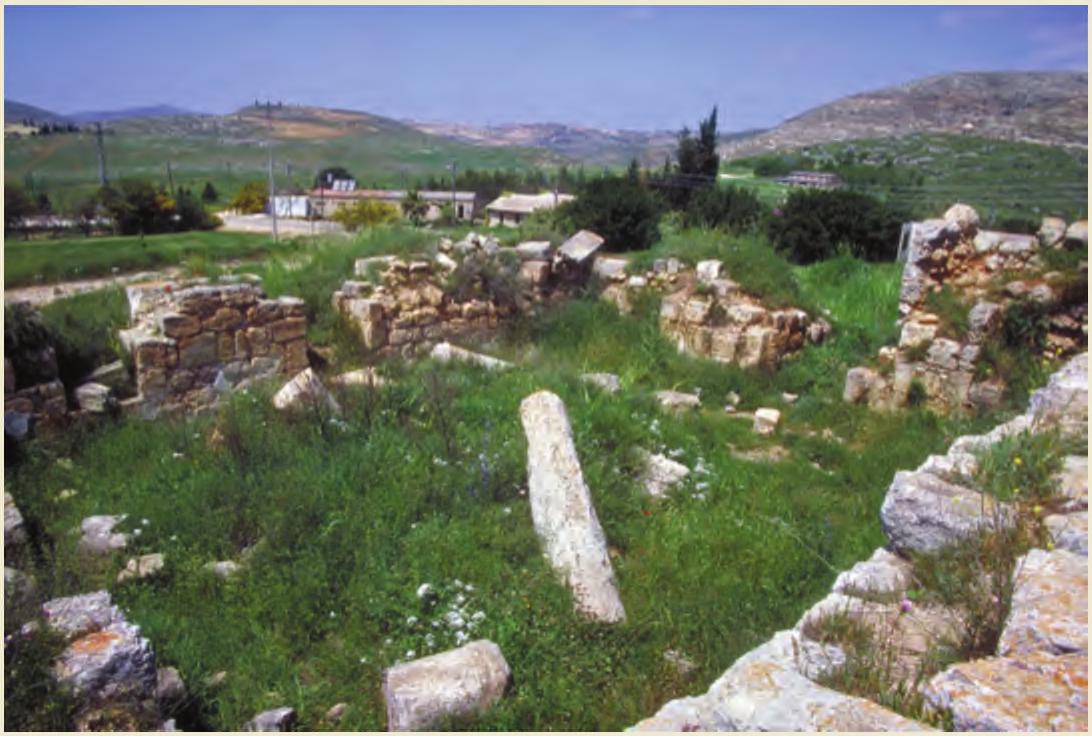
Part of the Iron Age ruins of Shiloh
© 1995 by Phoenix Data Systems
A Sobering Object Lesson
Shiloh was a sobering object lesson for Judah. Once the center of Israel’s religious life and the site of the tabernacle (see
1 Sam. 1:3), Shiloh lay in ruins in Jeremiah’s day, and its people had been taken captive by the Assyrians. Why? Because
the northern kingdom of Israel had turned away from the Lord to idols. Jeremiah warned that the same outcome awaited
the people of Jerusalem—and for the same reason (Jer. 7:12–15).
Jeremiah’s message of judgment must have sounded incredible. Jerusalem was the site of the temple, the magnificent
house of worship that David had envisioned and Solomon had built to the glory of God (see 2 Chr. 5:1). How could God
allow His temple and its city to be destroyed? Yet if anyone doubted Jeremiah’s warning, all they had to do was travel a
little more than 20 miles north to Shiloh.
Apparently, few people heeded
the prophet’s word, because Jeru-
salem fell to the Babylonians within
a few short years. The temple was
burned and most of the people
were either killed or deported.
This tragic outcome challenges
us to consider whether idols exist in
our own lives. We don’t bow down
to images of wood and stone, but if
we allow anything to take the place
of God, then we are practicing idol-
atry. This can happen in our work,
in our relationships, and, like the
people of ancient Judah, even in
our houses of worship. In that case,
God may take away the thing that
we hold so dear in order to redi-
rect our attention and affection to
where they belong—on Him. The
first commandment is still in effect:
“You shall have no other gods
before Me” (Ex. 20:3).
Original illustrations
End of source page 1210