PRINTED PAGE 1158NKJV · STUDY EDITION
1158 Jeremiah INTRODUCTION
deported to Babylon. Gedaliah was appointed governor of Judah at Riblah. Jere-
miah, who had been imprisoned by Zedekiah, was released and sent to serve under
Gedaliah. Gedaliah was assassinated and his supporters fled to Egypt, fearful of
Nebuchadnezzar’s revenge. Jeremiah went with them to Egypt against his will,
and there he continued to confront the Jews for their idolatry and unfaithfulness.
Structure The structure and organization of the Book of Jeremiah have per-
plexed interpreters for generations. A brief examination of passages with explicit
historical notes proves that the material is not ordered chronologically. Instead,
the organization of the oracles, prose sermons, and other material is based on
content, audience, and connective links. The division is as follows: (1) the call of
Jeremiah (ch. 1); (2) the judgment of Judah and Jerusalem (chs. 2–24); (3) Jeremiah’s
ministry to the nations (chs. 25–51); (4) an historical appendix recounting the fall
of Jerusalem (ch. 52). This arrangement gives balance and unity to the lengthy
prophetic text.
Message Jeremiah’s prayers, confessions, laments, and dialogues reveal the
depth of the prophet’s understanding of the character of God and the nature of
His relationship to people. For Jeremiah, the God of Israel was the incomparable
God of all creation, the Lord over nature and history. He reigned not only over
Judah and Israel but over all
nations (25:13).
The thread that wove
together Jeremiah’s knowl
edge of God was his under-
standing of the word of God.
It permeated the prophet’s
life and speech, for God
Himself promised to touch
Jeremiah’s mouth and infuse
His words into Jeremiah’s
mind and speech (1:9). From
then on, God’s words were
like an unquenchable fire
burning within the proph-
et’s soul (20:9).
Jeremiah was keenly
aware of the provisions
of the covenant between
God and Israel. The cove-
nant bound Israel to God
in a special relationship of
love, faithfulness, and hope.
But the covenant had two
sides. Faithfulness to the Lord and the covenant would bring blessing; disobedi-
ence would result in punishment, destruction, and exile (see Deut. 27:14—28:68).
Jeremiah called the people to obey the words of the covenant and to turn from
their idolatry and their unjust treatment of one another (11:6, 7).
Jeremiah’s message of judgment also contained a word of hope: a righteous
remnant would be restored. The land had been defiled by the people’s idolatry. The
leaders had brought the nation to the brink of disaster and the people were exiled.
But based on His everlasting love for Israel, God promised to bring the people back
from captivity and restore them to blessing (30:18—31:6). Israel’s enemies would
be defeated (30:16), and the people would sing joyfully of God’s goodness (31:12).
Christ in the Scriptures
Although Jeremiah’s references to Jesus are not as numerous as Isaiah’s, they are equally as strong. He paints
a word picture of the Messiah in 23:1–8 in which we see Him as the coming Shepherd, righteous Branch, and
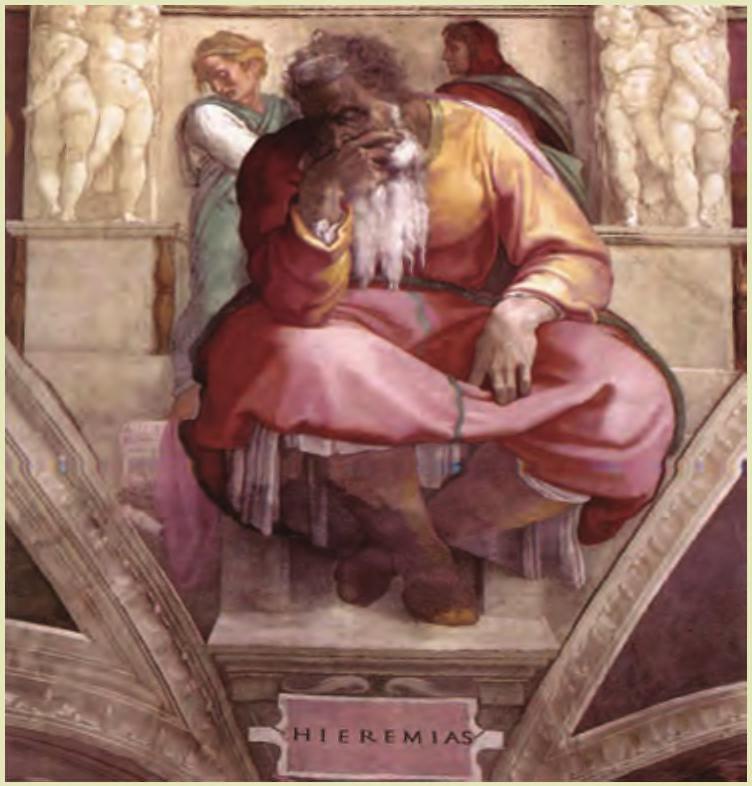
Sistine Chapel painting of the prophet Jeremiah by
Michelangelo
Wikimedia Commons
722 b.c.
Israel is conquered
by the Assyrians
640 b.c.
Josiah becomes
king in Judah
626 b.c.
Jeremiah is called
to prophesy
612 b.c.
Assyria falls to the
Babylonians and
Medes
609 b.c.
Jehoahaz’s reign
begins in Judah
608 b.c.
Jehoiakim’s reign
begins in Judah
605 b.c.
Nebuchadnezzar’s
reign begins in
Babylon
598 b.c.
Jehoiachin
becomes king in
Judah
598 b.c.
Zedekiah becomes
Judah’s last king
586 b.c.
Jerusalem falls to
the Babylonians
585 b.c.
Jeremiah is taken
to Egypt
Original illustrations
End of source page 1193