PRINTED PAGE 1149NKJV · STUDY EDITION
Isaiah 62:7 | 1149
10 t Hab. 3:18 u Ps.
132:9, 16 v Is. 49:18;
Rev. 21:2
11 w Ps. 72:3; 85:11
x Is. 60:18; 62:7
CHAPTER 62
1 1 keep silent
2 a Is. 60:3 b Ps.
102:15, 16; 138:4, 5;
148:11, 13 c Is. 62:4,
12; 65:15
3 d Is. 28:5; Zech.
9:16; 1 Thess. 2:19
4 e Hos. 1:10; 1 Pet.
2:10 f Is. 49:14; 54:6,
7 g Is. 54:1 2 Heb.
Azubah 3 Heb.
Shemamah
4 Lit. My Delight Is in
Her 5 Lit. Married
5 h Is. 65:19
6 i Is. 52:8; Jer.
6:17; Ezek. 3:17;
33:7 6 not be silent
7 remember
7 j Is. 60:18; 61:11;
Jer. 33:9; Zeph.
3:19, 20
61:10 I and the parallel My soul refer to personified Zion. Re-
joice is translated “joy” in v. 3 (see also 65:18). Clothed signifies
the Servant’s new glorified status or condition (47:2; 52:1; 59:17).
Ornaments is translated “beauty” in v. 3. bride: For a similar image
see 49:18.
61:11 spring forth: This phrase is also found in 42:9; 43:19; 45:8
to describe the coming of God’s salvation. Righteousness here
means “deliverance” (54:17). before all the nations: For related
passages see 52:10; 60:2, 3.
62:2 The repetition of righteousness (v. 1) shows that the divine
oracle and the prophet’s comment are linked. A new name, like
new clothing (61:10), signifies a new status (Gen. 17:5, 15; 32:28; Rev.
2:17). For the new names see vv. 4, 12.
62:3 Zion does not receive a crown of glory, or royal diadem, but
is one in the hand of the Lord.
62:4 The name Forsaken is a symbolic name for Jerusalem (see the
symbolic name Immanuel in 7:14). It appears as the name of a person
in 1 Kin. 22:42. For related references see 54:6; 60:15. Desolate: The
term is also found in 49:8, 19; 54:1. Hephzibah and Beulah are
symbolic names, although Hephzibah does appear as a personal
name at 2 Kin. 21:1. The names are explained in the end of the verse.
62:6, 7 I refers to the Lord (vv. 1, 8). Watchmen refers to prophets
(56:10). You who make mention of the Lord is Isaiah’s synonym
for “watchmen” and shows that the prophets were intercessors.
The phrases do not keep silent and give Him no rest relate the
prophets’ prayer to the Lord’s promises in v. 1 (see 64:12; 65:6).
But you shall be called 4 Hephzibah,
and your land 5 Beulah;
For the LORD delights in you,
And your land shall be married.
5 For as a young man marries a virgin,
So shall your sons marry you;
And as the bridegroom rejoices over
the bride,
h So shall your God rejoice over you.
6 i I have set watchmen on your walls,
O Jerusalem;
They shall 6 never hold their peace
day or night.
You who 7 make mention of the
LORD, do not keep silent,
7 And give Him no rest till He
establishes
And till He makes Jerusalem j a
praise in the earth.
10 t I will greatly rejoice in the LORD,
My soul shall be joyful in my God;
For u He has clothed me with the
garments of salvation,
He has covered me with the robe of
righteousness,
v As a bridegroom decks himself with
ornaments,
And as a bride adorns herself with
her jewels.
11 For as the earth brings forth its bud,
As the garden causes the things that
are sown in it to spring forth,
So the Lord GOD will cause
w righteousness and x praise
to spring forth before all the
nations.
Assurance of Zion’s Salvation
62
For Zion’s sake I will not 1 hold
My peace,
And for Jerusalem’s sake I will not
rest,
Until her righteousness goes forth as
brightness,
And her salvation as a lamp that
burns.
2 a The Gentiles shall see your
righteousness,
And all b kings your glory.
c You shall be called by a new name,
Which the mouth of the LORD will
name.
3 You shall also be d a crown of glory
In the hand of the LORD,
And a royal diadem
In the hand of your God.
4 e You shall no longer be termed
f Forsaken,2
Nor shall your land any more be
termed g Desolate;3
righteousness
(Heb. tsedeq) (62:1; Ps. 45:7; 85:10; 132:9; Prov. 1:3) Strong’s
#6664
This term denotes conformity to an ethical or moral stan-
dard. It occurs in reference to honorable business dealings
(Gen. 30:33; Lev. 19:36; Deut. 25:15) and proper speech (Ps.
52:3; Prov. 8:8). The term is used most often in relation to
one’s standing with legal authorities, either human or
divine. The word is frequently found in the context of other
legal terms such as judgment or justice (Lev. 19:15; Ps. 23:3;
72:2; 119:6–8). Righteousness, judgment, and justice are
declared to be the foundation of God’s throne (Ps. 89:14;
97:2). God’s righteousness is associated with deliverance.
It is in this context that one of the divine names of God is
revealed: “The Lord Our Righteousness” (41:10; 51:5; Jer.
23:6; 33:16).
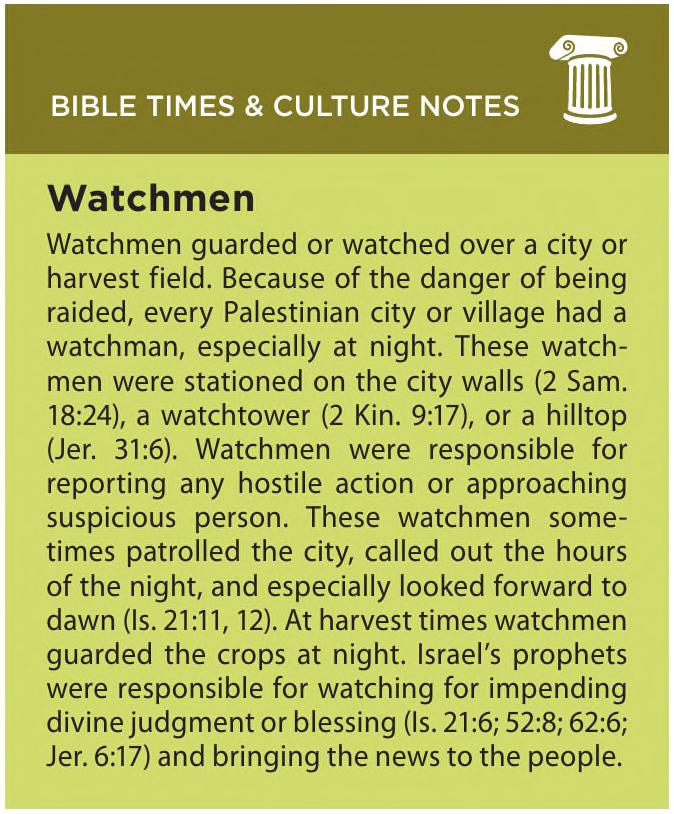
Bible Times & Culture Notes
Watchmen
Watchmen guarded or watched over a city or
harvest field. Because of the danger of being
raided, every Palestinian city or village had a
watchman, especially at night. These watch-
men were stationed on the city walls (2 Sam.
18:24), a watchtower (2 Kin. 9:17), or a hilltop
(Jer. 31:6). Watchmen were responsible for
reporting any hostile action or approaching
suspicious person. These watchmen some-
times patrolled the city, called out the hours
of the night, and especially looked forward to
dawn (Is. 21:11, 12). At harvest times watchmen
guarded the crops at night. Israel’s prophets
were responsible for watching for impending
divine judgment or blessing (Is. 21:6; 52:8; 62:6;
Jer. 6:17) and bringing the news to the people.
Original illustrations
End of source page 1184