PRINTED PAGE 1137NKJV · STUDY EDITION
Isaiah 53:10 | 1137
7 h Matt. 26:63; 27:12-14; Mark 14:61; 15:5 ; Luke 23:9; John
19:9 i Acts 8:32, 33 ; Rev. 5:6 8 j Matt. 27:11-26; Luke 23:1-
25 k [Dan. 9:26] 6 confinement 9 l Matt. 27:57-60 ; Luke
23:33 m 1 Pet. 2:22; 1 John 3:5 7 Lit. he or He 10 n John 1:29;
Acts 2:24 ; [2 Cor. 5:21] 8 crush
2 1 Stately form
2 splendor 3 Lit.
appearance
3 b Ps. 22:6; [Is.
49:7 ; Matt. 27:30,
31; Luke 18:31-33;
23:18] c [Heb. 4:15]
d [John 1:10, 11]
4 Or forsaken 5 Lit.
pains 6 Lit. sickness
4 e [Matt. 8:17 ;
Heb. 9:28; 1 Pet.
2:24] 7 Lit.
sicknesses 8 Lit.
pains 9 reckoned
1 Struck down
5 f [Is. 53:10; Rom.
4:25 ; 1 Cor. 15:3,
4] g [1 Pet. 2:24,
25] 2 Or pierced
through 3 crushed
4 Blows that cut in
6 5 Lit. has caused
to land on Him
For the transgressions of My people
He was stricken.
9 l And 7 they made His grave with the
wicked—
But with the rich at His death,
Because He had done no violence,
Nor was any m deceit in His mouth.
10 Yet it pleased the LORD to 8 bruise
Him;
He has put Him to grief.
When You make His soul n an
offering for sin,
He has no 1 form or 2 comeliness;
And when we see Him,
There is no 3 beauty that we should
desire Him.
3 b He is despised and 4 rejected by men,
A Man of 5 sorrows and c acquainted
with 6 grief.
And we hid, as it were, our faces
from Him;
He was despised, and d we did not
esteem Him.
4 Surely e He has borne our 7 griefs
And carried our 8 sorrows;
Yet we 9 esteemed Him stricken,
1 Smitten by God, and afflicted.
5 But He was f wounded 2 for our
transgressions,
He was 3 bruised for our iniquities;
The chastisement for our peace was
upon Him,
And by His g stripes 4 we are healed.
6 All we like sheep have gone astray;
We have turned, every one, to his
own way;
And the LORD 5 has laid on Him the
iniquity of us all.
7 He was oppressed and He was
afflicted,
Yet h He opened not His mouth;
i He was led as a lamb to the slaughter,
And as a sheep before its shearers is
silent,
So He opened not His mouth.
8 He was j taken from 6 prison and
from judgment,
And who will declare His
generation?
For k He was cut off from the land of
the living;
root. A root out of dry ground suggests Christ’s rejection by Israel
(49:4; 50:6). No form or comeliness indicates that the Servant did
not have a majestic manner.
53:3 He is despised and rejected: For related references describ-
ing the rejection of the Servant, see 42:2; 49:7; 50:6 (compare Mark
9:12). Man of sorrows does not indicate that the coming One would
be humorless or dour, but He knew better than anyone the havoc
that sin brings into human life. Because He is a “Man of sorrows,” He
is able to comfort those who experience sorrow.
53:4 He has borne: The Savior Jesus came to suffer and die for the
sins of others (53:6, 11, 12; Matt. 8:17; Heb. 9:28; 1 Pet. 2:24). Griefs—
or pain—and sorrows—or sickness—refer to the consequences of
sin. The people considered Christ to have been smitten by God
because the law said, “he who is hanged [on a tree] is accursed of
God” (Deut. 21:22, 23; Gal. 3:13).
53:5 The repetition of the pronouns He, Him, and His for our and
we underscores the fact that the Servant suffered in our place. The
chastisement . . . His stripes: For a similar reference, see 1 Pet.
2:24. Peace sums up the Servant’s ministry of reconciliation, justi-
fication, adoption, and glorification (2 Cor. 5:17–21). By saying that
they were healed (v. 4), the remnant expressed its faith in what God
had announced in 52:13.
53:6 All we like sheep have gone astray: For a NT perspective,
see 1 Pet. 2:25.
53:7 Opened not His mouth speaks of the Servant’s willingness
to die for sinners; it also marks His dignity and authority (Matt. 26:67,
68; 27:12–14; 1 Pet. 2:23). as a lamb to the slaughter: For similar
imagery, see John 1:29, 36; 1 Cor. 5:7; Rev. 5:6, 12; 13:8.
53:8 cut off from the land of the living: This language clearly
indicates that the Servant would die.
53:9 Often in Hebrew poetry, the rich appear as synonymous
with the wicked. Joseph of Arimathea was a rich man, but he
was not wicked (Matt. 27:57–60). at His death: The Hebrew term
death is in the plural, as a focus on the deep significance of Christ’s
death.
53:10 it pleased the Lord: The OT pointed to the doctrine of
the atonement long before Jesus died for our sins (see 1 Cor. 15:3
where Paul speaks of the doctrine coming from “the Scriptures”).
The atonement was part of God’s eternal plan (Eph. 1:4–7). The Fa-
ther was pleased that His Son should die because it would cover up
the sins of many and reconcile them to Himself (see v. 11). Offering
refers to the “trespass offering,” the sacrifice of a ram in order to
secure the Lord’s atonement for sin (Lev. 5:6, 7, 15; 7:1; 14:12; 19:21).
Here the prophet Isaiah describes the Servant Jesus as a trespass
offering. His seed refers to the spiritual seed, born to the Servant
after His death (see Gal. 3:26–29).
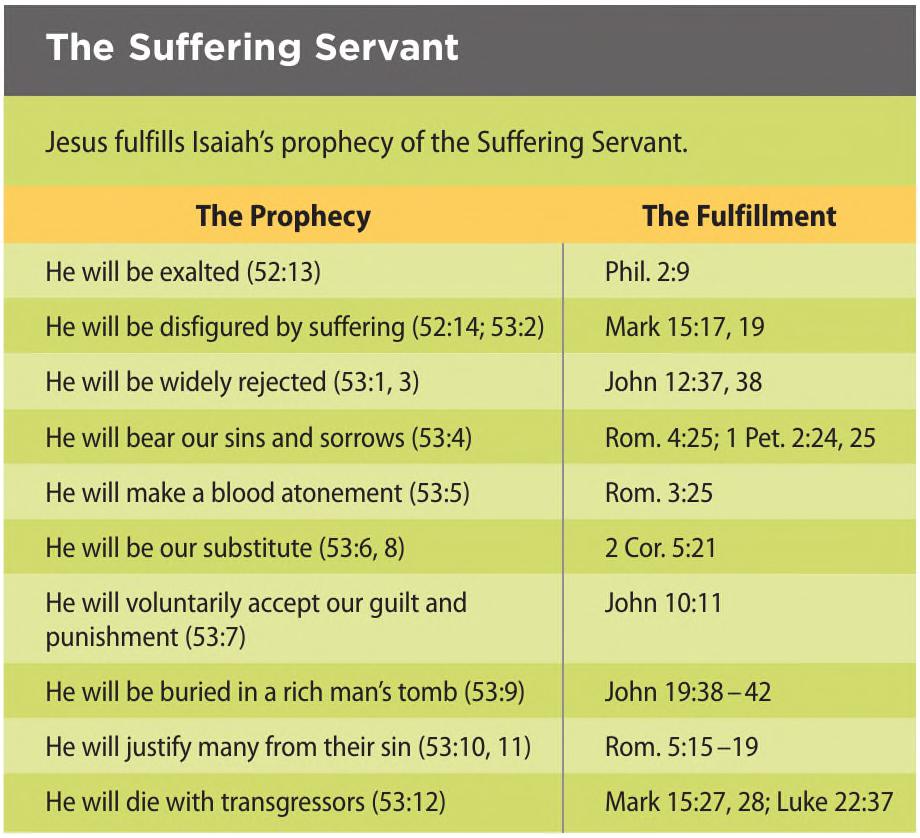
The Suffering Servant
Jesus fulfills Isaiah’s prophecy of the Suffering Servant.
The Prophecy
The Fulfillment
He will be exalted (52:13)
Phil. 2:9
He will be disfigured by suffering (52:14; 53:2)
Mark 15:17, 19
He will be widely rejected (53:1, 3)
John 12:37, 38
He will bear our sins and sorrows (53:4)
Rom. 4:25; 1 Pet. 2:24, 25
He will make a blood atonement (53:5)
Rom. 3:25
He will be our substitute (53:6, 8)
2 Cor. 5:21
He will voluntarily accept our guilt and
punishment (53:7)
John 10:11
He will be buried in a rich man’s tomb (53:9)
John 19:38 – 42
He will justify many from their sin (53:10, 11)
Rom. 5:15 –19
He will die with transgressors (53:12)
Mark 15:27, 28; Luke 22:37
Original illustrations
End of source page 1172