PRINTED PAGE 80NKJV · STUDY EDITION
80 | Genesis 45:3
3 c Gen. 43:27;
Acts 7:13
4 d Gen. 37:28; 39:1;
Ps. 105:17
5 e Gen. 45:7, 8;
50:20; Ps. 105:16, 17
6 f Gen. 43:1;
47:4, 13
7 g Gen. 45:5; 50:20
1 remnant
45:3 I am Joseph: Joseph must have said this in Hebrew and not
in Egyptian (42:23). Still, the brothers could not believe their ears.
They had sold Joseph as a slave. He would certainly be dead. Could
it be true? The Egyptian lord who held their lives in his hands was
their brother!
45:4 Joseph realized that his physical appearance, his Egyptian man-
ner, his high position, and his total power over them all conspired to
make his words unbelievable. He told them to come closer so that
they could recognize his face and voice. Joseph identified himself as
the brother whom they had sold. Fear overcame Joseph’s brothers
again. Would Joseph take revenge?
45:5 Joseph used kindness to calm his brothers’ fears. God sent me
before you to preserve life: God had worked through the brothers’
evil actions and hateful attitudes to preserve not only Jacob’s family,
but also the lives of many in the ancient world.
45:8 Joseph repeated that God had accomplished His good pur-
pose through the evil actions of his brothers. a father to Pharaoh:
Joseph was an advisor to Pharaoh much as a father might be an
advisor to his son.
do not therefore be grieved or angry with
yourselves because you sold me here; e for
God sent me before you to preserve life.
6 For these two years the f famine has been
in the land, and there are still five years
in which there will be neither plowing
nor harvesting. 7 And God g sent me be-
fore you to preserve a 1 posterity for you
in the earth, and to save your lives by a
great deliverance. 8 So now it was not you
aloud, and the Egyptians and the house
of Pharaoh heard it.
3 Then Joseph said to his brothers, c “I
am Joseph; does my father still live?”
But his brothers could not answer him,
for they were dismayed in his presence.
4 And Joseph said to his brothers, “Please
come near to me.” So they came near.
Then he said: “I am Joseph your brother,
d whom you sold into Egypt. 5 But now,
Joseph’s Story
The remarkable story of Joseph’s rise to power in Egypt is not just another rags-to-riches story. Fundamentally, the story
is about how the Lord created a nation out of a troubled family.
Jacob’s family was plagued by jealousy. Rachel envied Leah, and Leah envied Rachel (30:1). Leah’s sons inherited this
pattern of jealousy. They envied Joseph so much that they sold him as a slave (37:28). It may even be that Reuben abused
Bilhah because of jealousy toward Benjamin (35:18–22). Also, the family was separating. After Joseph was sold into slavery,
Judah left the family, associated with the Canaanites, and married a Canaanite woman (38:1–3). Simeon followed Judah’s
lead by also taking a Canaanite wife (46:10). With these jealousies and divisions, Jacob’s family, the family of God’s eternal
promises (12:1–3), was becoming more and more like the pagan Canaanite community around them.
But the Lord did not let the troubles of this family thwart His good purposes. He had promised to shape a great nation
from it—a nation that would spread His blessings to the whole earth (12:1–3). Jacob’s family was divided, but God worked
the events so that the family was reunited. Through a remarkable series of circumstances, God elevated Joseph from
the position of slave and prisoner to administrator of Egypt, Pharaoh’s right-hand man. God transformed the evil plans
of Joseph’s brothers into something good (37:19–28; 50:20). As the administrator of the Egyptians’ plan to survive the
coming famine, Joseph could save the lives of many people in the world. With his new name, Zaphnath-Paaneah (“The
God Speaks and Lives”), and his remarkable story,
Joseph could witness to these people about the
power and goodness of the living God (41:45).
But God’s good plan did not end there. God
used the physical hardship of famine to reunite
Israel’s family. When Joseph’s brothers saw him,
not only did they express sorrow for their former
evil actions (42:21; 45:5), but they demonstrated
a new loyalty to their other half brother, Benja-
min. Judah, who had left the family before (38:1),
begged for Benjamin’s life, even at the cost of his
own freedom (44:18–34). The reunion of the fam-
ily and the pressures of famine prompted Jacob
to move closer to Egypt, to the land of Goshen.
God used the evil attitudes of the Egyptians—
their hatred of shepherds—to isolate the family
there (43:32; 46:34). In this isolation, God could
develop a nation dedicated to worshiping and
obeying Him.
In all the exceptional events of Joseph’s
story, God remained faithful to His promises to
Abraham (12:1–3). He created a great nation out
of Jacob’s family through a maze of human jeal-
ousy, family divisions, and racial hatred (50:20).
Joseph’s rise to power in Egypt is ultimately about God’s faithfulness
to His promises (12:1–3).
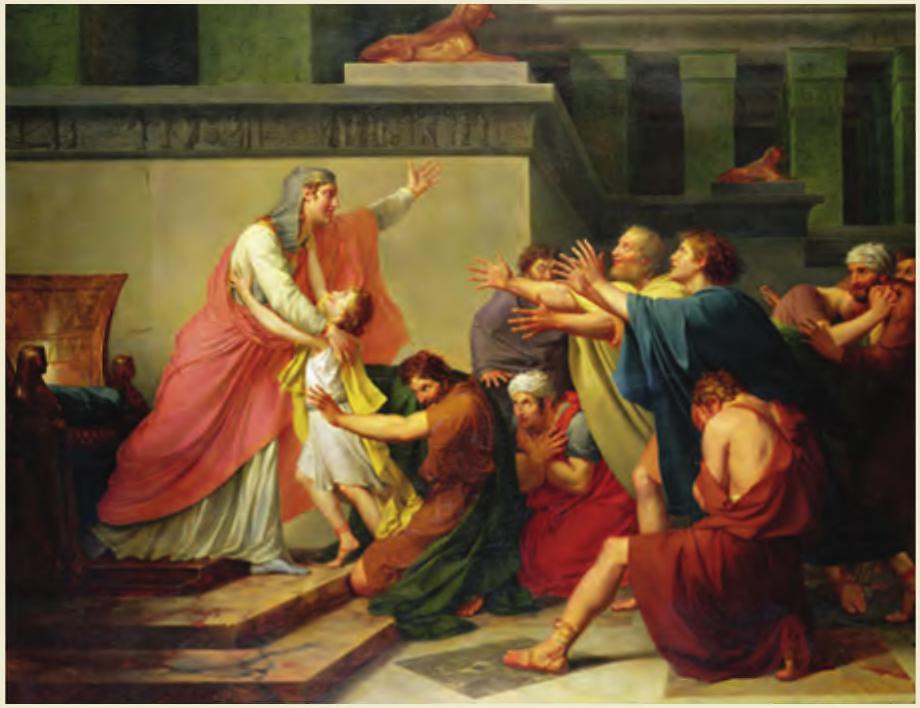
Joseph Recognised by His Brothers, Gerard, Francois Pascal Simon, Baron/Musee
des Beaux-Arts, Angers, France/Giraudon/The Bridgeman Art Library
Original illustrations
End of source page 115