PRINTED PAGE 1079NKJV · STUDY EDITION
Isaiah 15:4 | 1079
And destroyed,
Because in the night Kir of Moab is
laid waste
And destroyed,
2 He has gone up to the 2 temple and
Dibon,
To the high places to weep.
Moab will wail over Nebo and over
Medeba;
d On all their heads will be baldness,
And every beard cut off.
3 In their streets they will clothe
themselves with sackcloth;
On the tops of their houses
And in their streets
Everyone will wail, e weeping bitterly.
4 Heshbon and Elealeh will cry out,
Their voice shall be heard as far as
f Jahaz;
Then a his yoke shall be removed
from them,
And his burden removed from their
shoulders.
26 This is the b purpose that is purposed
against the whole earth,
And this is the hand that is stretched
out over all the nations.
27 For the LORD of hosts has c purposed,
And who will annul it?
His hand is stretched out,
And who will turn it back?”
Philistia Destroyed
28 This is the 9 burden which came in
the year that d King Ahaz died.
29 “ Do not rejoice, all you of Philistia,
e Because the rod that struck you is
broken;
For out of the serpent’s roots will
come forth a viper,
f And its offspring will be a fiery flying
serpent.
30 The firstborn of the poor will feed,
And the needy will lie down in safety;
I will kill your roots with famine,
And it will slay your remnant.
31 Wail, O gate! Cry, O city!
All you of Philistia are dissolved;
For smoke will come from the north,
And no one will be alone in his
1 appointed times.”
32 What will they answer the
messengers of the nation?
That g the LORD has founded Zion,
And h the poor of His people shall
take refuge in it.
Proclamation Against Moab
15
The a burden 1 against Moab.
Because in the night b Ar of c Moab is
laid waste
eignty. yoke . . . his burden: In 9:4, these same terms are used of
the Assyrian menace.
14:28–32 After an introduction (v. 28), the oracle against Philistia
falls roughly into two cycles: (1) the annihilation of the Philistines
and the preservation of God’s poor and needy (vv. 29, 30); (2) the
destruction of Philistine cities and the founding of Zion (vv. 31, 32).
14:28 King Ahaz died in 720 b.c.
14:29 Rod is probably a metaphor for the Assyrian king (10:5). its
offspring will be . . . serpent: More trouble would come upon
Philistia; it would have nothing for which to rejoice.
14:30 Like Babylon (v. 22)—but unlike Israel—Philistia would have
no future, because it would have no remnant.
14:31 The gate of a walled city was its weakest point. When the
gate fell, the city could be taken. The Assyrian army would come
from the north. No one will be alone speaks of the close ranks
of the Assyrian army.
14:32 founded Zion: The destruction of Philistia would leave no
refuge for the Philistines. The only place they could go to be saved
would be Jerusalem, the city built by God. That would be the place
to which the poor of all nations could come, becoming God’s peo-
ple (Ps. 87).
15:1—16:14 The oracle against Moab has five parts: (1) an editorial
superscript (15:1); (2) the sudden, devastating destruction of Moab
(15:2–9); (3) a plea from Moab for shelter in Zion (16:1–5); (4) a reflec-
tion contrasting Moab’s former pride with its fallen state (16:6–12);
(5) a postscript (16:13, 14).
15:1 For the origin of the people of Moab, see the story of Lot and
his daughters in Gen. 19:30–38 (see also Num. 22–25; Deut. 1:5). bur-
den: For similar phrasing, see 13:1. Ar and Kir were cities of Moab
(16:7, 11; Deut. 2:9; 2 Kin. 3:25).
15:2 He refers collectively to Moab. High places were sites of
pagan worship (16:12). weep . . . wail: This refers to the mourning
over the destruction of the cities of Moab. Baldness and having
one’s beard cut off were aspects of mourning rituals.
15:3 Sackcloth and weeping were part of Middle Eastern mourn-
ing rites (Gen. 23:2; 37:34; 2 Sam. 1:11, 12).
15:4 Heshbon, Elealeh, and Jahaz were cities in Moab. armed sol-
diers: The weeping would extend even to hardened fighting men.
25 a Is. 10:27; Nah.
1:13
26 b Is. 23:9; Zeph.
3:6, 8
27 c 2 Chr. 20:6;
Job 9:12; 23:13; Ps.
33:11; Prov. 19:21;
21:30; Is. 43:13; Dan.
4:31, 35
28 d 2 Kin. 16:20;
2 Chr. 28:27
9 oracle, prophecy
29 e 2 Chr. 26:6
f 2 Kin. 18:8
31 1 Or ranks
32 g Ps. 87:1, 5
h Zech. 11:11
CHAPTER 15
1 a 2 Kin. 3:4
b Deut. 2:9; Num.
21:28 c Is. 15:1–
16:14; Jer. 25:21;
48:1-47; Amos
2:1-3; Zeph. 2:8-11
1 oracle, prophecy
2 d Lev. 21:5; Jer.
48:37 2 Heb. bayith,
lit. house
3 e Jer. 48:38
4 f Num. 21:28; 32:3;
Jer. 48:34
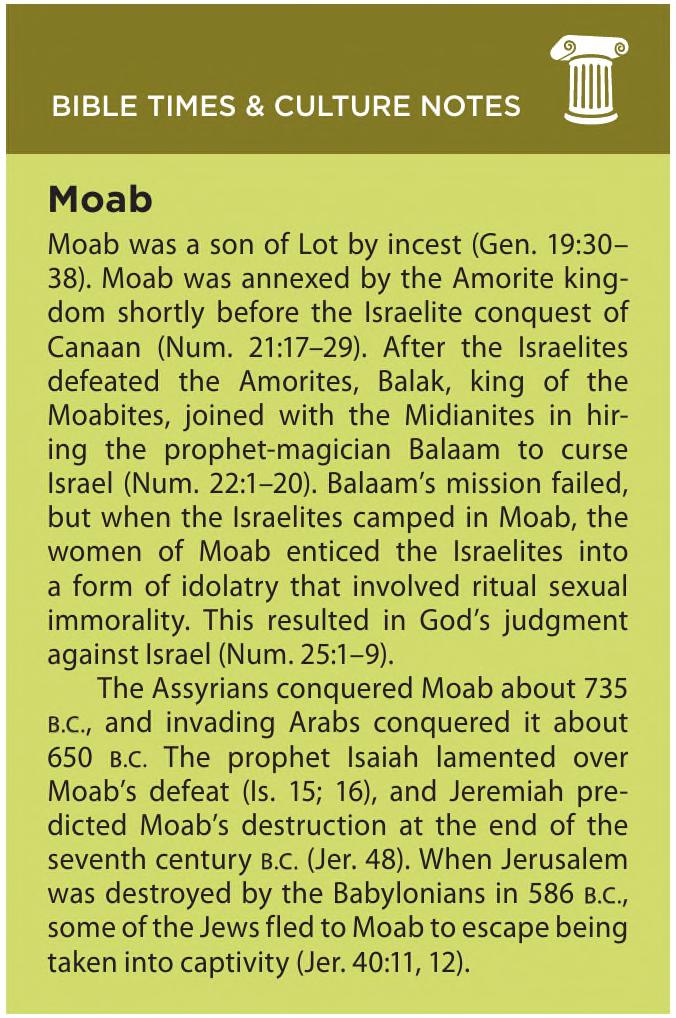
Bible Times & Culture Notes
Moab
Moab was a son of Lot by incest (Gen. 19:30–
38). Moab was annexed by the Amorite king-
dom shortly before the Israelite conquest of
Canaan (Num. 21:17–29). After the Israelites
defeated the Amorites, Balak, king of the
Moabites, joined with the Midianites in hir-
ing the prophet-magician Balaam to curse
Israel (Num. 22:1–20). Balaam’s mission failed,
but when the Israelites camped in Moab, the
women of Moab enticed the Israelites into
a form of idolatry that involved ritual sexual
immorality. This resulted in God’s judgment
against Israel (Num. 25:1–9).
The Assyrians conquered Moab about 735
b.c., and invading Arabs conquered it about
650 b.c. The prophet Isaiah lamented over
Moab’s defeat (Is. 15; 16), and Jeremiah pre-
dicted Moab’s destruction at the end of the
seventh century b.c. (Jer. 48). When Jerusalem
was destroyed by the Babylonians in 586 b.c.,
some of the Jews fled to Moab to escape being
taken into captivity (Jer. 40:11, 12).
Original illustrations
End of source page 1114