PRINTED PAGE 1061NKJV · STUDY EDITION
Isaiah 5:1 | 1061
it of burning, 5 then the LORD will create
above every dwelling place of Mount
Zion, and above her assemblies, h a cloud
and smoke by day and i the shining of a
flaming fire by night. For over all the glory
there will be a 2 covering. 6 And there will
be a tabernacle for shade in the daytime
from the heat, j for a place of refuge, and
for a shelter from storm and rain.
God’s Disappointing Vineyard
5
Now let me sing to my Well-beloved
A song of my Beloved a regarding
His vineyard:
The Renewal of Zion
2 In that day d the Branch of the LORD
shall be beautiful and glorious;
And the fruit of the earth shall be
excellent and appealing
For those of Israel who have escaped.
3 And it shall come to pass that he who
is left in Zion and remains in Jerusalem
e will be called holy—everyone who is
f recorded among the living in Jerusalem.
4 When g the Lord has washed away the
filth of the daughters of Zion, and purged
the 1 blood of Jerusalem from her midst,
by the spirit of judgment and by the spir-
would have to beg a man to father their children and take away
their reproach—the fact that they have no children. Most of the
men of Jerusalem would have died in the process of defending the
city (3:25).
4:2–6 The prophecy of Zion’s restoration has three parts: (1) the
Branch of the Lord will be glorious (v. 2); (2) the remnant will be
sanctified (vv. 3, 4); (3) the Lord will provide a protective covering
over Mt. Zion (vv. 5, 6).
4:2 In that day speaks of the future revelation of the glory of the
Lord on the earth (2:2–4). The Branch of the Lord has the double
sense of the earth yielding its fruit and of Christ yielding spiritual
fruit (11:1–5; Jer. 23:5; Zech. 3:8; John 15:1–8). Because Christ humbled
Himself, He will be crowned with glory (49:7; 52:13; 53:12; Phil. 2:9–11).
beautiful and glorious: Together the words indicate “dazzling
beauty.” The reign of Jesus the King of Creation will be marked by
plenty. The earth will be released from its curse, producing all that
God intended it to produce in the beginning (Ps. 65).
4:3 recorded: The record of births in Jerusalem (Ps. 87:5, 6) may
be related to the heavenly “book” (Ex. 32:32; Ps. 69:28; Dan. 7:10;
Rev. 20:12).
4:4 Spirit could mean wind (the hot searing wind of fire), the human
spirit, or the Holy Spirit. All three may be intended (11:2; 30:1; 42:1;
48:16; 59:21; 61:1; Luke 3:22). The spirit of judgment . . . burning
means “a fiery judgment.” Through the processes of a purging fire,
which outwardly consumes the faithless and inwardly purifies the
faithful, God will produce a holy city.
4:5 Create is something only God can do; the word also suggests
a divine “refashioning.” Cloud and smoke recalls God’s protec-
tive presence at the Red Sea (Ex. 13:20–22), on the tabernacle
(Ex. 40:34–38), and in the wilderness (Num. 9:15–23). Here the phrase
symbolizes His protective covering over the restored and sancti-
fied Mt. Zion. The glory of Mt. Zion in the messianic age will be
bestowed by God Himself (40:5; 60:2; John 17:10, 22, 24).
4:6 Over the cloud and smoke on each dwelling will be the over-
shadowing tabernacle, symbolizing God’s protection of and com-
munion with His people (Ps. 91:1; Rev. 21:3).
5:1–7 Isaiah’s “Song of the Vineyard” is in three parts: (1) an intro-
duction to the allegory (vv. 1, 2); (2) an accusation and sentence
(vv. 3–6); (3) an interpretation of the allegory (v. 7; see Ps. 80:8–16).
5:1–3 Judah is likened to a vineyard that has every advantage. Its
2 d Is. 12:1-6; [Jer.
23:5]; Zech. 3:8
3 e Is. 60:21 f Phil.
4:3
4 g Mal. 3:2, 3
1 bloodshed
5 h Ex. 13:21, 22;
Num. 9:15-23
i Zech. 2:5 2 canopy
6 j Ps. 27:5; Is. 25:4
CHAPTER 5
1 a Ps. 80:8; Jer.
2:21; Matt. 21:33;
Mark 12:1; Luke
20:9
Bible Times & Culture Notes
Grapes and Vineyards
Grapes grew plentifully in Palestine
and the Hebrews devoted much
time to their vineyards. The planting,
pruning, and cropping of grapevines
was hard work that many people
considered to be menial (2 Kin. 25:12).
Yet the hill country of Judah offered
grapevines a perfect climate. Walled
vineyards and watchtowers came to
symbolize the land of Judah.
To prepare a hillside for plant-
ing a vineyard, a farmer had to clear
rocks from the ground and build
stone hedges to hold the soil. The
vines were planted in rows eight to
ten feet apart. By forbidding farmers
to gather grapes for the first three
years (Lev. 19:23), Mosaic Law guar-
anteed that the vines would be well-
tended in their formative years. After
clusters began to form again, pruners
cut off twigs having no fruit. Wine
was squeezed in September, and the
Hebrews celebrated this occasion.
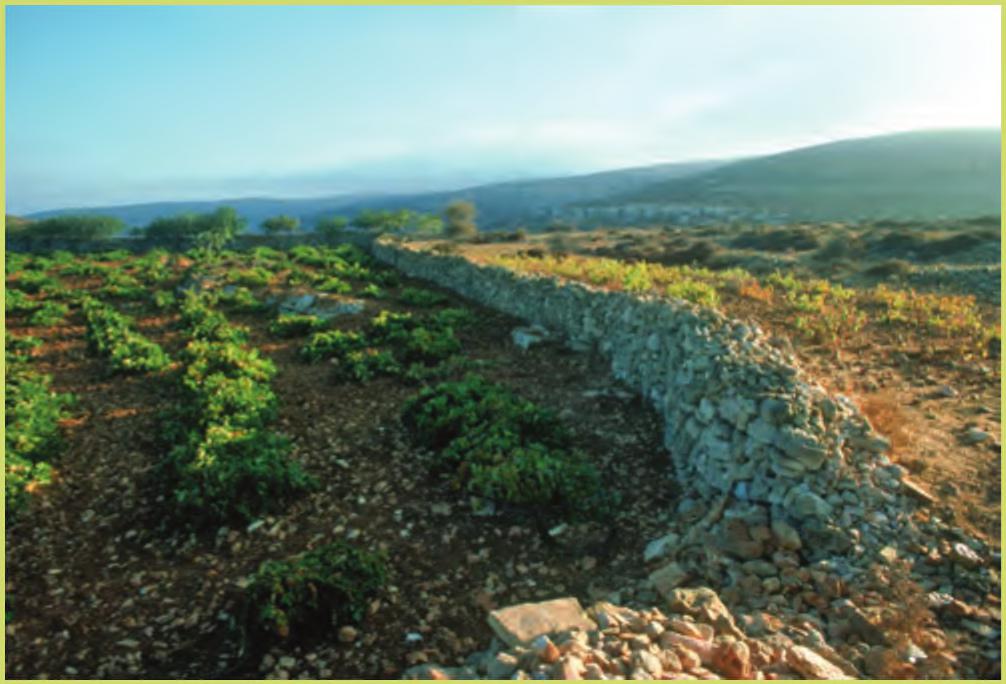
A view of a well-tended vineyard in the hill country of Judah. The farmer
removed the stones from the soil (Is. 5:2) in order to build the retaining wall
(Ps. 80:12, 13). Most of the vines in Palestine trail on the ground, because it is
believed that the grapes ripen more slowly under the shadow of the leaves.
www.HolyLandPhotos.org
Original illustrations
End of source page 1096