PRINTED PAGE 1052NKJV · STUDY EDITION
1052 Isaiah INTRODUCTION
the entire book. The apostle John attributed prophecies from 53:1 as well as from
6:9, 10 to the prophet Isaiah ( John 12:38–41). Thus there is no convincing reason
to discount Isaiah’s authorship of the entire book.
Interpretation Understanding Hebrew prophetic literature involves recognizing
and interpreting parallelism. The Hebrews used parallelism in poetry and prophecy
as a literary technique to emphasize a particular thought. Here is an example: “The
ox knows its owner / and the donkey its master’s crib; / but Israel does not know, /
My people do not consider” (1:3). In the first part of this verse, both the ox and the
donkey intuitively know the objects that they depend on, the owner (provider) as
well as the “master’s crib” (provision). The second part of the verse contrasts the
intuition of animals with the behavior of the Israelites. Israel does not know “its
Owner,” and even though they are God’s “people,” they “do not consider” God’s
provision. Thus the second half of the verse creates the analogy in parallel with
the first half.
Prophetic poetry uses colorful images that point to further meanings. Unlike
prose, which addresses historical realities more directly, poetry draws its readers
and listeners into spiritual realities with the
use of evocative language. Thus in 42:15,
the images of “mountains and hills”
represent all sorts of obstacles—both
physical and spiritual—to the exiles’
return to Jerusalem. The promise that
the Lord would “dry up” these obsta-
cles means that He would eliminate all
impediments to the exiles’ return, just
as He had dried up the Red Sea for the
Israelites long before. Similarly in 41:18,
that the Lord would “open rivers” and
make “the dry land springs of water”
means that He would miraculously pro-
vide for the returning exiles in the same
way He had provided water from a rock
(Ex. 17:1–6).
Another major element in under-
standing prophetic literature is recogniz-
ing that the prophecies themselves and
their arrangement often lack chrono-
logical perspective or have multiple
fulfillments. For example, the same
prophecy may speak of both Jesus’
First and Second Comings (63:1, 2).
Likewise, one prophecy may speak of
both the virgin birth of Jesus as well as
the birth of Isaiah’s son during Pekah’s
invasion. Moreover, an oracle about
the servant Cyrus, the Persian emperor
of the sixth century b.c. (41:1–29), may
stand next to a prophecy concerning
the Servant Jesus (42:1–9). Ultimately, the interpretations of Jesus
and the New Testament authors provide a guide for interpreting Old
Testament prophecies.
Audience As a prophet, Isaiah spoke to three historical epochs.
In chapters 1–39, he delivered his message of condemnation to the
eighth-century Israelites, pronouncing judgment on their immoral
and idolatrous lifestyles. This judgment came quickly, for during
Isaiah’s ministry, Tiglath-Pileser III (745–727 b.c.) set out to extend
Assyria’s rule into the west, and in doing so put pressure on Israel
and Judah. In 722 b.c. another Assyrian king, Sargon II, conquered
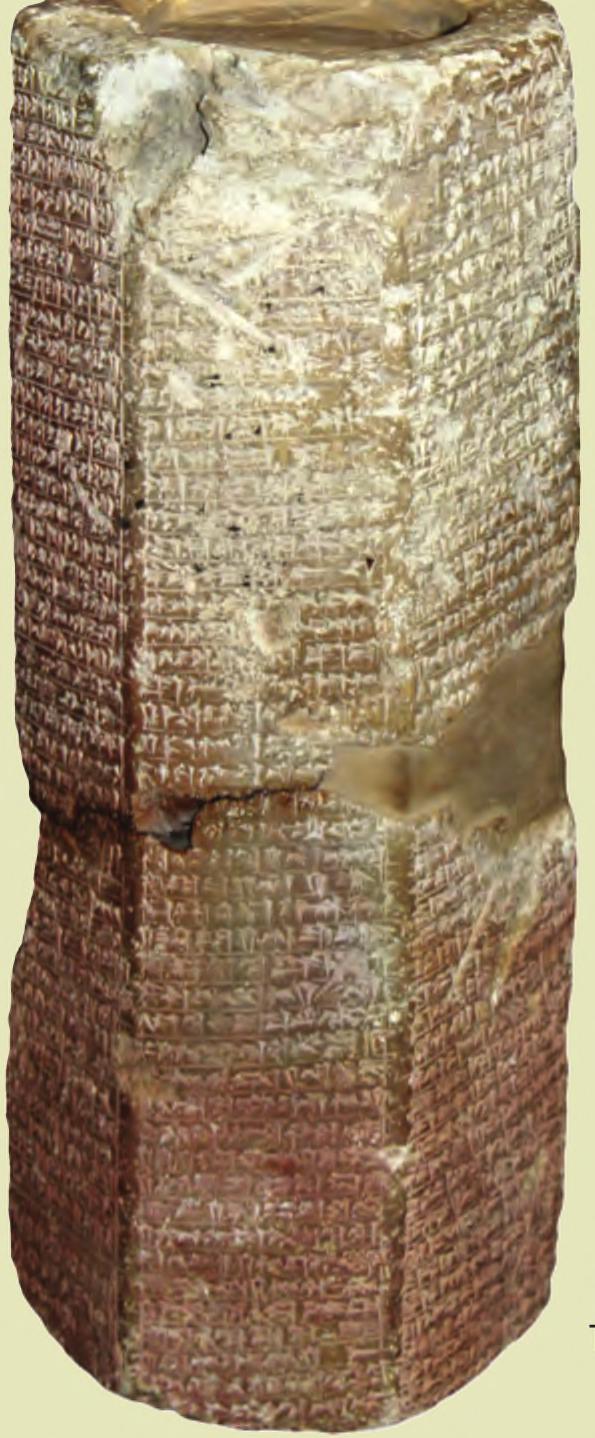
The Annals of King Sargon II, one of the
kings of Assyria during Isaiah’s ministry.
In 722 – 721 b.c. Samaria, the capital of the
northern kingdom of Israel, was finally
taken by Sargon II after a three-year
siege started by Shalmaneser V.
© 2013 by Zondervan
930 b.c.
The northern
and southern
kingdoms divide
792 b.c.
Azariah (Uzziah)
becomes king in
Judah
755 b.c.
Isaiah begins to
prophesy in Judah
752 b.c.
Jotham’s reign
begins in Judah
736 b.c.
Ahaz begins his
reign in Judah
734 b.c.
Israel and Syria
war against Judah
732 b.c.
Damascus falls to
the Assyrians
729 b.c.
Hezekiah becomes
king in Judah
722 b.c.
The northern
kingdom is taken
captive by the
Assyrians
Original illustrations
End of source page 1087