PRINTED PAGE 1026NKJV · STUDY EDITION
1026 | Ecclesiastes 1:15
heart has 6 understood great wisdom and
knowledge.” 17 p And I set my heart to
know wisdom and to know madness and
folly. I perceived that this also is grasping
for the wind.
18 For q in much wisdom is much grief,
And he who increases knowledge
increases sorrow.
The Vanity of Pleasure
2
I said a in my heart, “Come now, I
will test you with b mirth; 1 therefore
enjoy pleasure”; but surely, c this also was
vanity. 2 I said of laughter—“Madness!”;
and of mirth, “What does it accomplish?”
3 d I searched in my heart how 2 to grati-
fy my flesh with wine, while guiding my
heart with wisdom, and how to lay hold
on folly, till I might see what was e good
for the sons of men to do under heaven
all the days of their lives.
4 I made my works great, I built myself
f houses, and planted myself vineyards. 5 I
made myself gardens and orchards, and
I planted all kinds of fruit trees in them.
6 I made myself water pools from which
to 3 water the growing trees of the grove.
7 I acquired male and female servants,
and had 4 servants born in my house. Yes,
I had greater possessions of herds and
15 n What is crooked cannot be made
straight,
And what is lacking cannot be
numbered.
16 I communed with my heart, say-
ing, “Look, I have attained greatness,
and have gained o more wisdom than all
who were before me in Jerusalem. My
1:15 Solomon is not claiming that there is no use trying to straight-
en out or change anything. R ather, he explains that no amount of
investigating or using the resources of earth will ever straighten
out all that is crooked, twisted, perverted, or turned upside down
(7:13).
1:16 all who were before me in Jerusalem: T his phrase does not
rule out Solomon as the author of the book just because he was
preceded in Jerusalem only by his father David. T here were other
kings including Melchizedek (Gen. 14:18) and Adoni-Zedek (Josh.
10:1). T he city of Jerusalem had existed for hundreds of years before
Solomon became its king.
1:17 It was not wisdom that Solomon judges absurd, but rather
becoming “more wise” (2:15) and “overly wise” (7:16).
1:18 much wisdom is much grief: For all of wisdom’s other ad-
vantages, Solomon confesses that much wisdom and learning are
the source of pain, chagrin, and sorrow. It is well known that the
very process of learning is an expansion of the awareness of our
ignorance. For mortals, an increase of wisdom may only increase
pain (12:12).
2:1 T he Preacher uses a literary device of conversing with himself
as a way of describing his thought processes. mirth: A new test
is proposed, following the test of wisdom. It is the test of “joy,”
or “pleasure.”
2:2 Solomon labels the lighter side of pleasure and joy as sheer
madness, but even the weightier aspects of laughter cause Solo-
mon to ask if anything substantial is really achieved. As Solomon
writes in Prov. 14:13, “Even in laughter the heart may sorrow, and
the end of mirth may be grief.”
2:3 flesh with wine . . . heart with wisdom: Here the test is an at-
tempt to balance excess on the one side with learning on the other.
2:4–6 I built myself houses: Solomon worked for 13 years build-
ing “the king’s house” (1 Kin. 9:10), then he built “the House of the
Forest of L ebanon” (1 Kin. 10:17), and another house for his wife,
Pharaoh’s daughter (1 Kin. 9:24). He also fortified the cities of Hazor,
Megiddo, Gezer, Beth Horon, Baalath, and Tadmor (1 Kin. 9:15, 17,
18). vineyards . . . gardens and orchards: Solomon’s interest
in the natural world (God’s creation) was prodigious (1 Kin. 4:33).
2:7, 8 Maintaining the various buildings and gardens of the king
must have demanded an extensive staff of servants. silver and
gold: Solomon’s riches were unsurpassed by the kings of the an-
cient world (1 Kin. 10:14–29). musical instruments: T he meaning
b Prov. 14:13; [Eccl. 7:4; 8:15] c Eccl. 1:2 1 gladness 3 d Eccl.
1:17 e [Eccl. 3:12, 13; 5:18; 6:12] 2 L it. to draw my flesh
4 f 1 Kin. 7:1-12 6 3 irrigate 7 4 L it. sons of my house
15 n Eccl. 7:13
16 o 1 Kin. 3:12, 13;
Eccl. 2:9 6 L it. seen
17 p Eccl. 2:3, 12;
7:23, 25; [1 T hess.
5:21]
18 q Eccl. 12:12
CHAPTER 2
1 a L uke 12:19
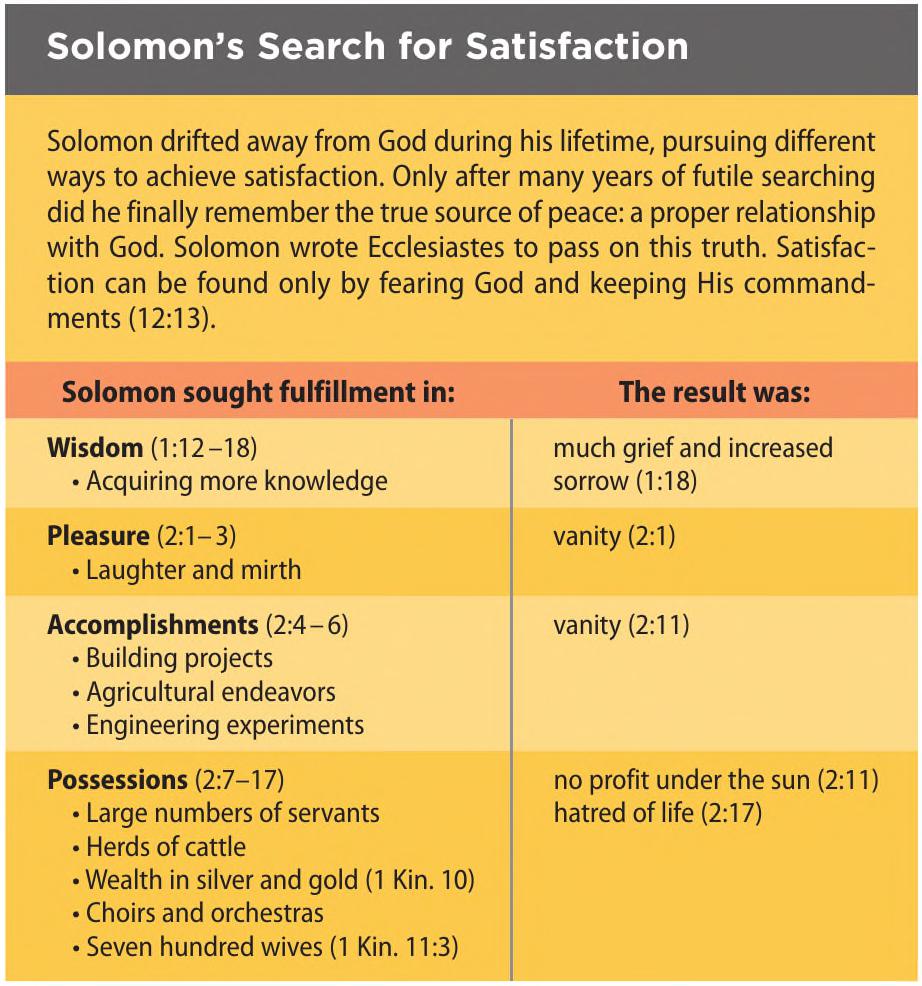
Solomon’s Search for Satisfaction
Solomon drifted away from God during his lifetime, pursuing different
ways to achieve satisfaction. Only after many years of futile searching
did he finally remember the true source of peace: a proper relationship
with God. Solomon wrote Ecclesiastes to pass on this truth. Satisfac-
tion can be found only by fearing God and keeping His command-
ments (12:13).
Solomon sought fulfillment in:
The result was:
Wisdom (1:12 –18)
• Acquiring more knowledge
much grief and increased
sorrow (1:18)
Pleasure (2:1– 3)
• Laughter and mirth
vanity (2:1)
Accomplishments (2:4 – 6)
• Building projects
• Agricultural endeavors
• Engineering experiments
vanity (2:11)
Possessions (2:7–17)
• Large numbers of servants
• Herds of cattle
• Wealth in silver and gold (1 Kin. 10)
• Choirs and orchestras
• Seven hundred wives (1 Kin. 11:3)
no profit under the sun (2:11)
hatred of life (2:17)
vanity
(Heb. hebel) (1:14; 2:1, 11; 6:12; 7:15; Ps. 78:33; Is. 49:4) Strong’s
#1892
T his word basically means “vapor” or “breath,” such as
the rapidly vanishing vapor of one’s warm breath in cool,
crisp air. With this word, the Preacher described worldly
pursuits—such as wealth, honor, fame, and various plea-
sures—as similar to desperately grasping at air (2:17).
It is absurd and useless. Jeremiah used the same word
to denounce idolatry as “worthless” (Jer. 18:15); and Job
used it to bemoan the brevity of human life (Job 7:16). But
the Preacher of Ecclesiastes used the word more than any
other OT author. According to him, all of life is vanity unless
one recognizes that everything is from the hand of God
(2:24–26).
Original illustrations
End of source page 1061