PRINTED PAGE 1023NKJV · STUDY EDITION
Ecclesiastes INTRODUCTION 1023
In fact, Solomon might have written this wisdom book as a tract for other nations. T hat would explain why
he did not write about the L aw, and why he used the divine title Elohim, meaning “Exalted God,” instead of
the covenantal name Yahweh in the book (Ex. 3:14, 15). Solomon had entertained many dignitaries from other
nations, including the queen of Sheba. T he queen’s questions concerning the basic meaning of life might have
prompted him to write Ecclesiastes to teach the Gentiles about the living God and their need to worship only
Him. Centuries before, Moses had called for this type of treatise to the pagan nations (Deut. 4:6–8). T he nations
that had heard of Israel’s success needed to know about the living and exalted God who had blessed Israel
with wealth and wisdom.
Themes Sometimes it is better to read the end of a book to understand better the direction in which the
book is headed. T his is certainly true of Ecclesiastes. T he book should be interpreted in light of its conclusion:
“Fear God and keep His commandments, for this is man’s all” (12:13). To fear God means to revere, worship, and
serve God—to turn from evil and turn in awe to the living God. T his was the attitude of Abraham (Gen. 22:12),
Job ( Job 1:1, 8, 9; 2:3), and the Egyptian midwives (Ex. 1:17, 21). It does not involve dread, but instead a proper
respect for and obedience to our Creator. Why should we respect and obey God? T he Book of Ecclesiastes
answers this question in its concluding verse (12:14): God will judge everyone—both the righteous and the
wicked. L ife cannot be lived with abandon, as if God will not see or remember the deeds of the past. For on
the final day, he will call forth all men and women to account for their actions. T he admonition to fear God and
the expectation of divine judgment are the two great themes that conclude the book and provide an interpre-
tative framework for the rest of it (see 12:13, 14).
T he journey of Solomon to his conclusion “to fear God” is founded on the human search for meaning in life.
In 3:11, Solomon eloquently expresses humankind’s dilemma: God has placed eternity in our hearts. A search for
true meaning in this life—in money or fame, for instance—will only leave us empty-handed, because our souls
yearn for something that will last. Our frustration arises from a hunger to fellowship with our eternal Creator—
the only One who can give meaning to our lives. In Ecclesiastes, Solomon takes us on a tour of all of life and
concludes that all of it is vanity. Pleasures and riches lead merely to boredom and despair. Only a relationship
with the One who created us and continues to care for us will truly satisfy. Troubles and uncertainty will continue
to plague us, but even during these times we can find joy in a secure trust in our Father.
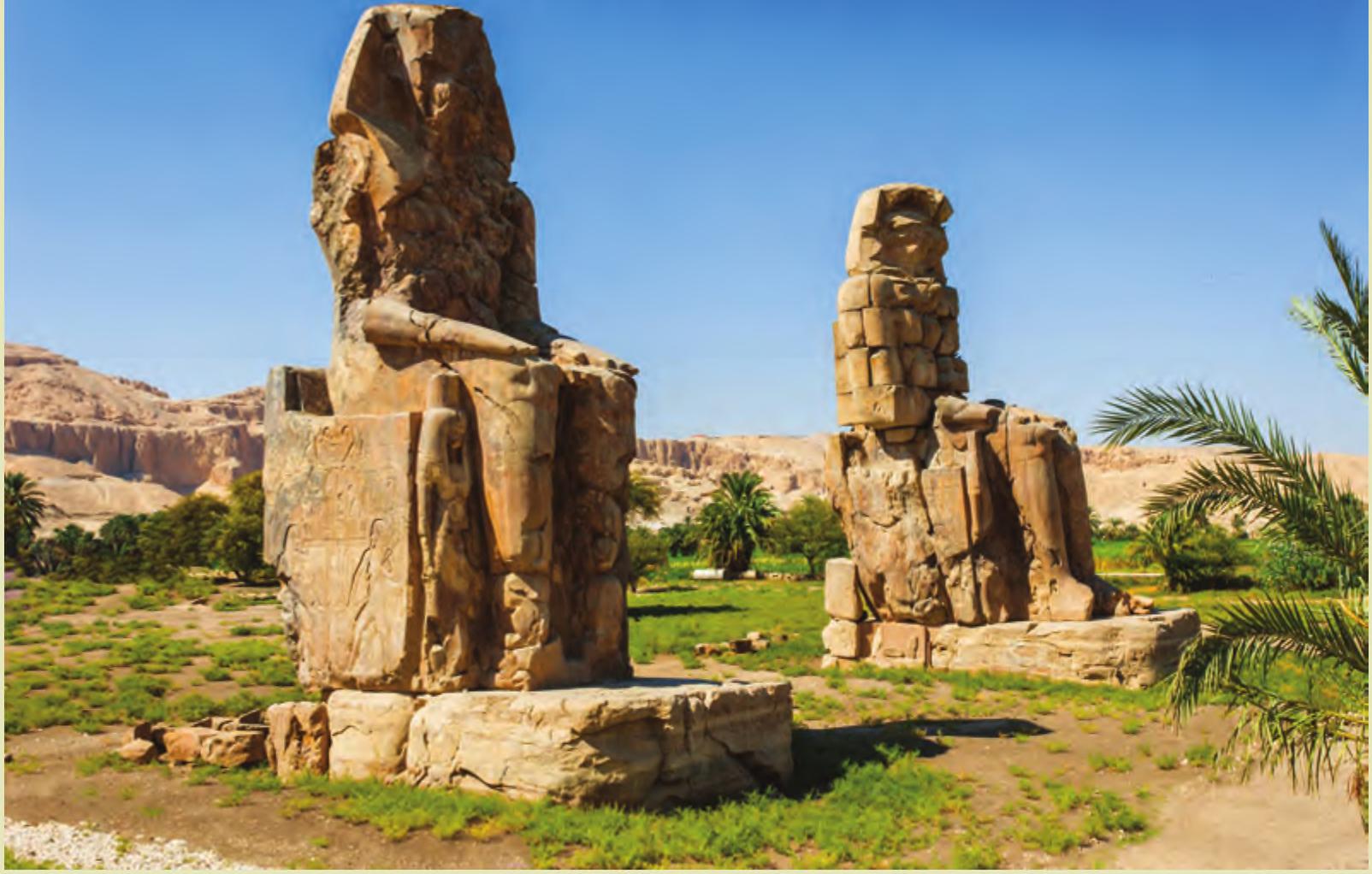
The Colossi of Memnon from the temple complex of Amunhotep III. The temple that once stood behind them was
destroyed long ago, a poignant reminder of the ultimate meaninglessness of power and glory.
© Zhukov Oleg/Shutterstock
Original illustrations
End of source page 1058