PRINTED PAGE 975NKJV · STUDY EDITION
Psalm 150:6 | 975
Psalm 150, a psalm of praise, is a development of the Hebrew
word hallelujah, meaning “Praise the Lord.” How fitting that this
book of praises—the meaning of the name of the Book of Psalms
in Hebrew—ends in repeated commands to praise the Lord. The
structure is as follows: (1) a call for the praise of God in heaven
above (v. 1); (2) a call for the praise of God for His great works (v. 2);
(3) a call for the praise of God with all instruments (vv. 3–5); (4) a call
for the praise of God from all creatures here below (v. 6).
150:1 in His sanctuary: The intent is for praise to come to God in
His dwelling in heaven (148:1–4).
150:3–5 The varied instruments in this section include horns, reeds,
strings, and percussion, encompassing many of the instruments
known in Israel at that time (33:2, 3; 98:4–6).
150:6 everything that has breath: The very breath that God
gives us should be used to praise Him. As long as we live we should
praise our Creator (146:1, 2). By His breath God created all things
(33:6), and by our breath we should adore Him. The Book of Psalms
begins with God’s blessing on the righteous (1:1) and concludes
with all of creation blessing its loving Creator.
PSALM 150 1 a Ps. 145:5, 6 1 Heb. Hallelujah 2 expanse of
heaven 2 b Deut. 3:24 3 3 cornet 6 4 Heb. Hallelujah
PSALM 150
Let All Things Praise the LORD
P
raisea 1 the LORD!
Praise God in His sanctuary;
Praise Him in His mighty 2 firmament!
2 Praise Him for His mighty acts;
Praise Him according to His excellent
b greatness!
3 Praise Him with the sound of the
3 trumpet;
Praise Him with the lute and harp!
4 Praise Him with the timbrel and
dance;
Praise Him with stringed
instruments and flutes!
5 Praise Him with loud cymbals;
Praise Him with clashing cymbals!
6 Let everything that has breath praise
the LORD.
4 Praise the LORD!
praise
(Heb. halal ) (146:1, 10; 147:1; 149:3; 150:1, 6) Strong’s #1984
The verb halal is a common Hebrew word for praise. It may
be used to exalt human beauty (Song 6:9), a virtuous wife
(Prov. 31:30), or a wise man (Prov. 12:8), but most frequently
halal is used to praise God. It often occurs in the imperative,
expressing an exhortation or command: “Praise!” (135:1)
or “Praise Him” (150:2). The most familiar example of the
imperative is halleluyah (meaning “Praise the Lord!”; see
146:1; 150:6), a combination of halal and the divine name
Yah. The last five psalms present a climax to the praises
contained in the Book of Psalms, commanding believers
(145:10), the Israelites (149:2), the angels (148:2), Jerusalem
itself (147:12), the heavens (148:1), and finally every being
that has breath (150:6) to praise the Almighty God, the Cre-
ator of the universe.
Bible Times & Culture Notes
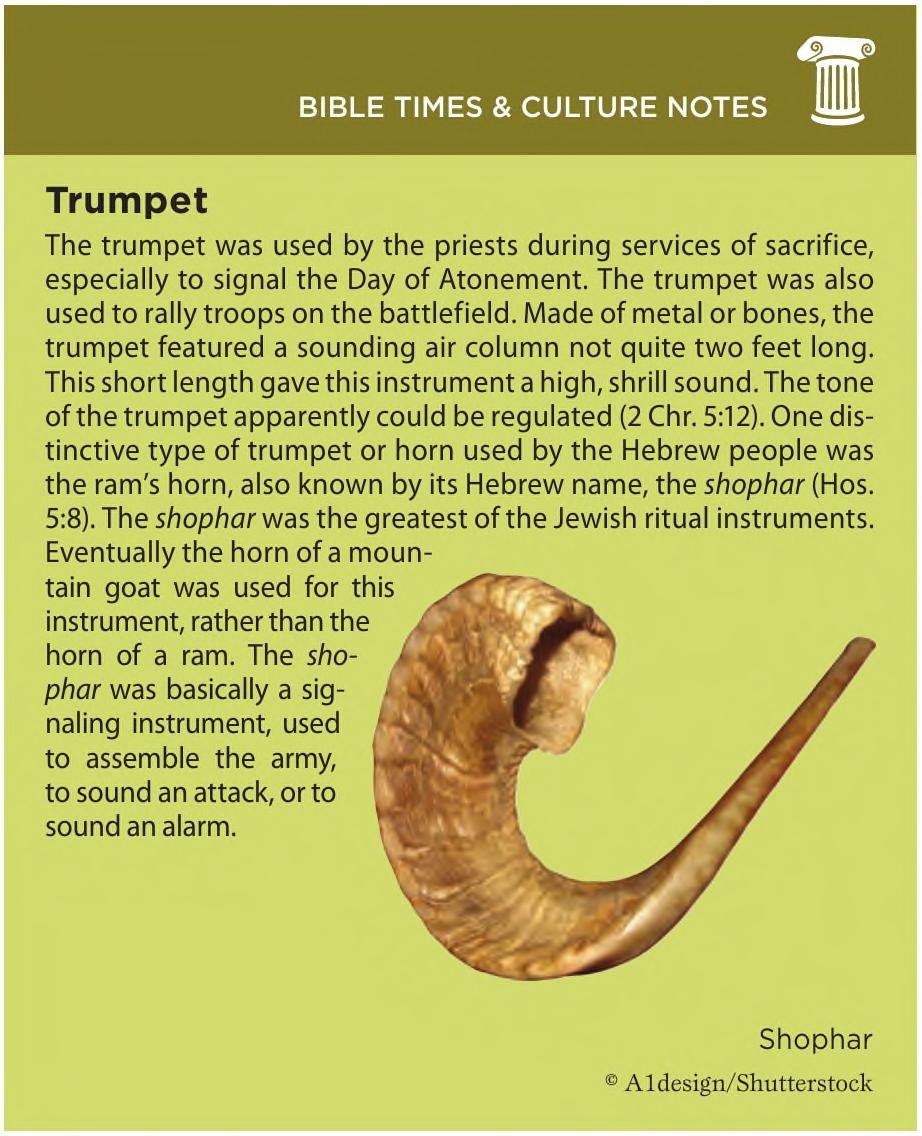
Trumpet
The trumpet was used by the priests during services of sacrifice,
especially to signal the Day of Atonement. The trumpet was also
used to rally troops on the battlefield. Made of metal or bones, the
trumpet featured a sounding air column not quite two feet long.
This short length gave this instrument a high, shrill sound. The tone
of the trumpet apparently could be regulated (2 Chr. 5:12). One dis-
tinctive type of trumpet or horn used by the Hebrew people was
the ram’s horn, also known by its Hebrew name, the shophar (Hos.
5:8). The shophar was the greatest of the Jewish ritual instruments.
Eventually the horn of a moun-
tain goat was used for this
instrument, rather than the
horn of a ram. The sho-
phar was basically a sig-
naling instrument, used
to assemble the army,
to sound an attack, or to
sound an alarm.
Shophar
© A1design/Shutterstock
Original illustrations
End of source page 1010